In brief
Denmark has no B2B e-invoicing mandate. There is no clearance, no central platform and no transaction reporting to the tax authority. Denmark doesn't need any of them. Since the 2022 Bookkeeping Act, the law has regulated the bookkeeping system rather than the invoice. For companies whose system is not registered with the Danish Business Authority, and that includes every Dynamics AX installation, those rules have applied since the first financial year starting on or after 1 January 2025. One of them is that the system must be able to send and receive invoices and credit notes in both OIOUBL and Peppol BIS, plus the response messages that go with them. From 1 March 2027, registered systems start enrolling Danish businesses in the NemHandel register by default. Between November 2028 and May 2029, OIOUBL 2.1 is retired in favour of Nemhandel BIS 4. If you run AX 4.0, AX 2009 or AX 2012 in Denmark, nobody is announcing a mandate. The question is whether your ERP passes a test it has been under since 2025.
Denmark was e-invoicing before most of Europe had settled on a format. Invoices to Danish public authorities have had to go through NemHandel since 2005. So while France built accredited platforms and Germany set turnover thresholds, Denmark looked like the country with nothing left to do.
That reading is half right. Denmark has chosen not to force businesses to send each other e-invoices. What it did instead is quieter. For anyone on an older ERP it is also more awkward, because it puts the requirement on the software. A Danish company may still email a PDF to another Danish company. Its bookkeeping system, however, must be able to do the structured version, in both directions.
On Dynamics 365 Finance, Microsoft carries most of that obligation. For the many Danish groups still running AX 4.0, AX 2009 or AX 2012, nobody carries it but the company. Here is the briefing a CFO or CIO in that position needs on one page.
What Denmark actually decided
The Bookkeeping Act (Act no. 700 of 24 May 2022) replaced the 1999 law and moved the focus from bookkeeping rules to bookkeeping systems. It splits the world in two.
Registered standard systems. A software vendor can register a standard bookkeeping system with the Danish Business Authority (Erhvervsstyrelsen). The vendor then answers for the system meeting the requirements. Dynamics 365 Finance is registered, under registration number fob314877.
Non-registered systems. Everything else: self-built systems, heavily customised installations, and on-premises ERPs whose vendor never registered them. Here the company answers for compliance itself, under Executive Order no. 205 of 29 February 2024. Dynamics AX sits in this group. Microsoft’s lifecycle FAQ is explicit that AX 2009 SP1, AX 2012 and AX 2012 R2 only received regulatory updates for laws enforced on or before 9 October 2018, and AX 2012 R3 left extended support on 10 January 2023. The Bookkeeping Act arrived after both.
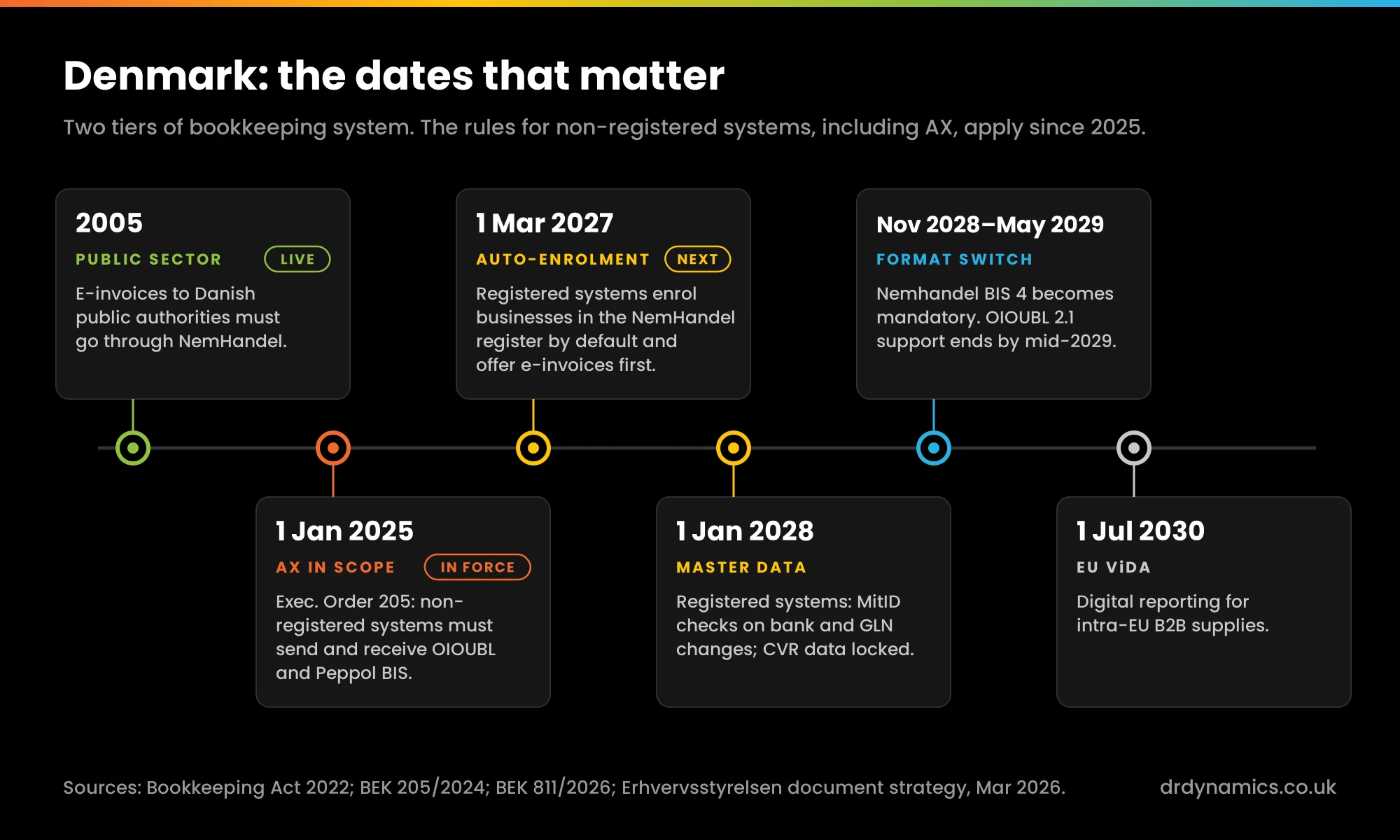
Executive Order 205 came into force on 1 January 2025. For companies in accounting classes B, C and D, it applies from the first financial year starting on or after that date. Smaller businesses outside the annual-report regime, with net turnover of at least DKK 300,000 in each of the two previous years, followed from income years starting in 2026. For a calendar-year company on AX, the clock started on 1 January 2025.
What the order asks of a non-registered system:
- Recording. Every transaction carries date, amount, voucher number, text and, for foreign currency, the exchange rate. The system assigns a registration date, a sequential ID and the user. Posted entries cannot be deleted, edited or backdated. Corrections are new postings.
- Vouchers. Purchase and sales vouchers are stored digitally with the content the act prescribes, including both parties’ CVR or SE numbers.
- Security and backup. Recognised IT security standards, including user and access management. A full backup at least weekly, kept by an unrelated third party on a server in the EU or EEA, for five years.
- Automation. Send and receive e-invoices and credit notes in OIOUBL via NemHandel and in Peppol BIS, with the response messages. Generate a SAF-T file as defined by the Danish Business Authority. Support bank reconciliation that shows differences clearly.
There is no registration step and no certificate to obtain. The Danish Business Authority can ask for information and can require an auditor’s statement that the system complies, at the company’s expense. KPMG Denmark notes that breaches can be fined and can lead to a remark in the annual report. The company finds out it was non-compliant when someone else writes it down.
The model: a network, not a platform
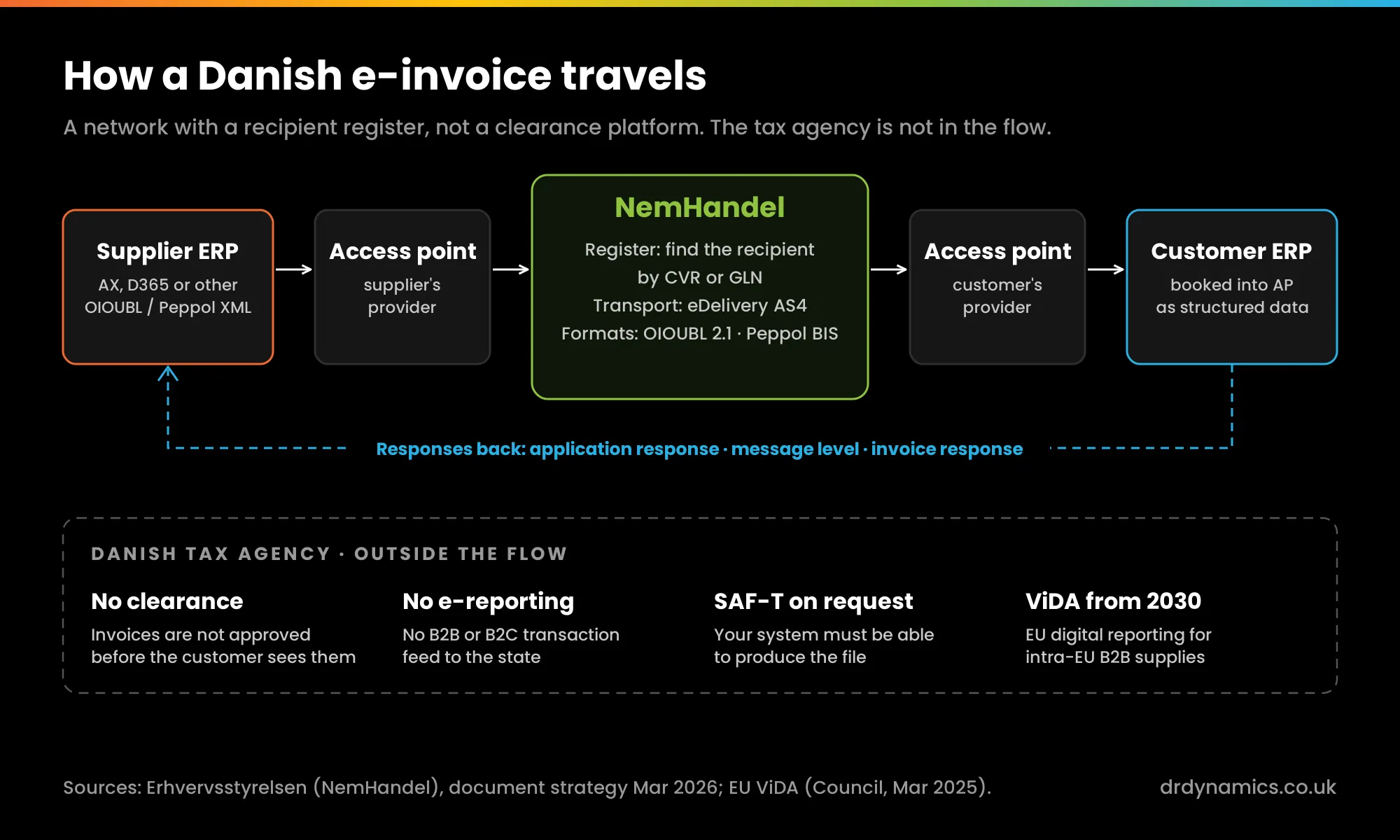
NemHandel is state-owned infrastructure with three parts: shared document standards (OIOUBL and Peppol BIS), a shared recipient register (NemHandelsregisteret) where businesses are found by CVR number or GLN, and a transport layer built on the European eDelivery AS4 standard. The register also works as a lookup inside the Peppol eDelivery infrastructure. An invoice travels from the supplier’s system to its access point, across the network, to the customer’s access point and into the customer’s system. Responses travel back the same way.
What is missing matters as much as what is there. No clearance: the tax agency does not approve your invoice before your customer sees it. No lifecycle statuses reported to the state. No e-reporting of B2B or B2C transactions. VAT returns are filed as before. SAF-T is a file your system must be able to produce when asked. Nobody uploads it monthly.
Is e-reporting coming? Not domestically, and nothing is on the legislative track. The next reporting obligation is the EU’s: under ViDA, adopted in March 2025, digital reporting for intra-EU B2B supplies starts on 1 July 2030. Denmark is moving its national format onto a Peppol and EN 16931 basis well before that.
The eleven things your ERP must do
This is what makes Denmark different from every other “voluntary” country.
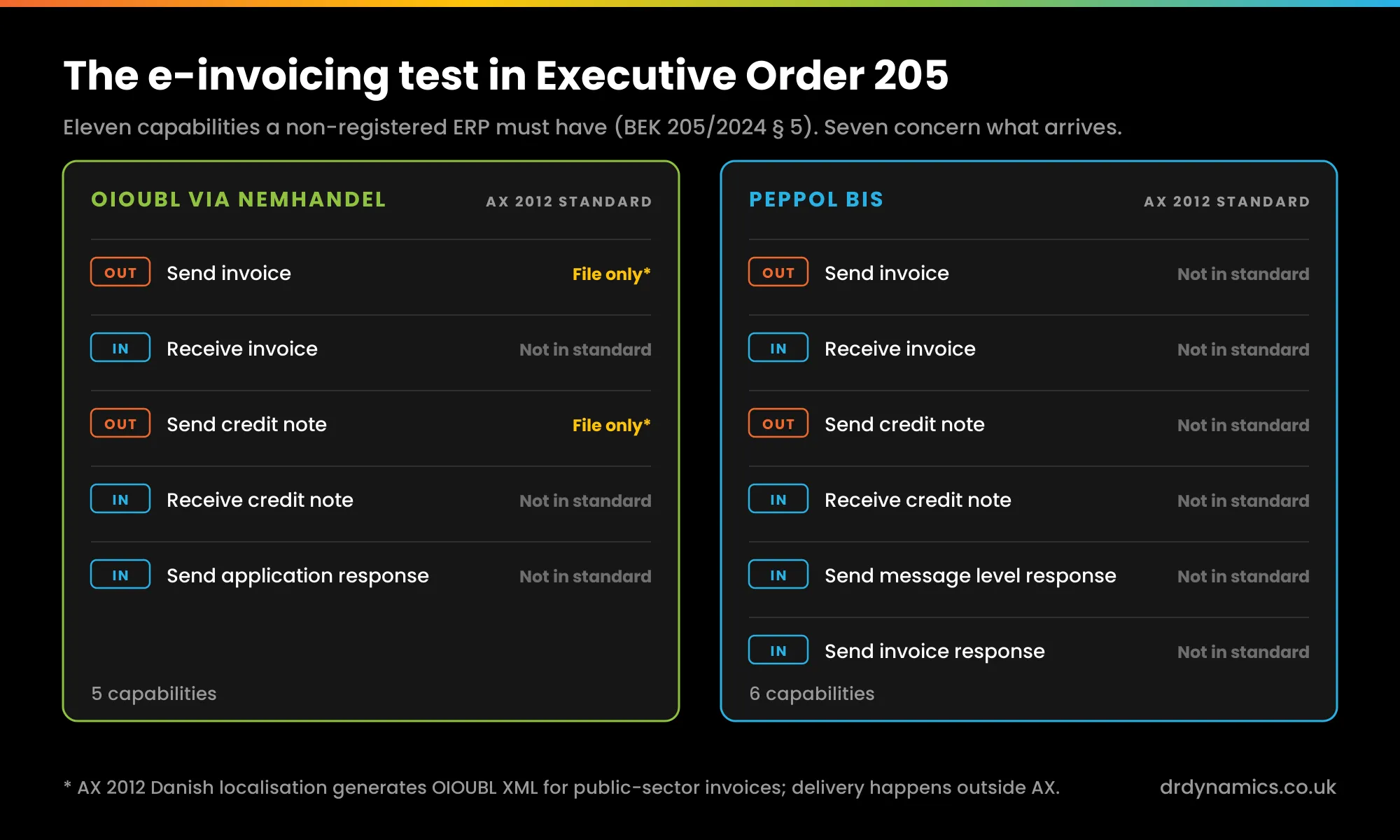
The order lists the e-invoicing requirement as eleven separate capabilities. In OIOUBL via NemHandel: send an invoice, receive an invoice, send a credit note, receive a credit note, and send an application response on receipt. In Peppol BIS: send an invoice, receive an invoice, send a credit note, receive a credit note, send a message level response, and send an invoice response.
Seven of the eleven are about what arrives, not what leaves. That is where most AX estates are thinnest.
AX 2012 does have a head start on the outbound side. Its Danish localisation generates OIOUBL XML for public-sector invoices and credit notes, with validation, because NemHandel has been mandatory for public-sector invoicing since 2005. That covers part of two capabilities, as a file someone still has to deliver. Receiving into the books, Peppol in either direction and the three response messages are not in the standard product, and no update will add them.
“Receive” is the word to read carefully. It means a structured supplier invoice can come into your system and be processed, not that a mailbox will accept an XML attachment. If AP still keys Danish supplier invoices from PDFs, that is the first gap an auditor will find.
1 March 2027: when “voluntary” starts to bite
Executive Order 811/2026, published in September 2026, sets the next stage for registered systems, moved from 1 January to 1 March 2027:
- Vendors must tell business customers not yet in the NemHandel register that they will be registered unless they decline within four weeks.
- When a user creates an invoice by hand, the system checks whether the recipient is registered and offers an e-invoice as a clear option.
- From 1 January 2028, identity checks through MitID when bank or GLN details change, and company master data retrieved from CVR and locked against manual edits.
None of this obliges anyone to send an e-invoice. Domestic B2B e-invoicing stays voluntary. But look at who runs registered systems: a large part of your Danish customer and supplier base, on cloud accounting packages and Dynamics 365. Through 2027 they become addressable on NemHandel by default, and their invoicing screens start offering e-invoices first. More structured invoices will arrive at your AX. More customers will ask why yours don’t arrive at theirs. The legal duty to handle them has been yours since 2025. From March, your trading partners start noticing.
OIOUBL is ending. Build once.
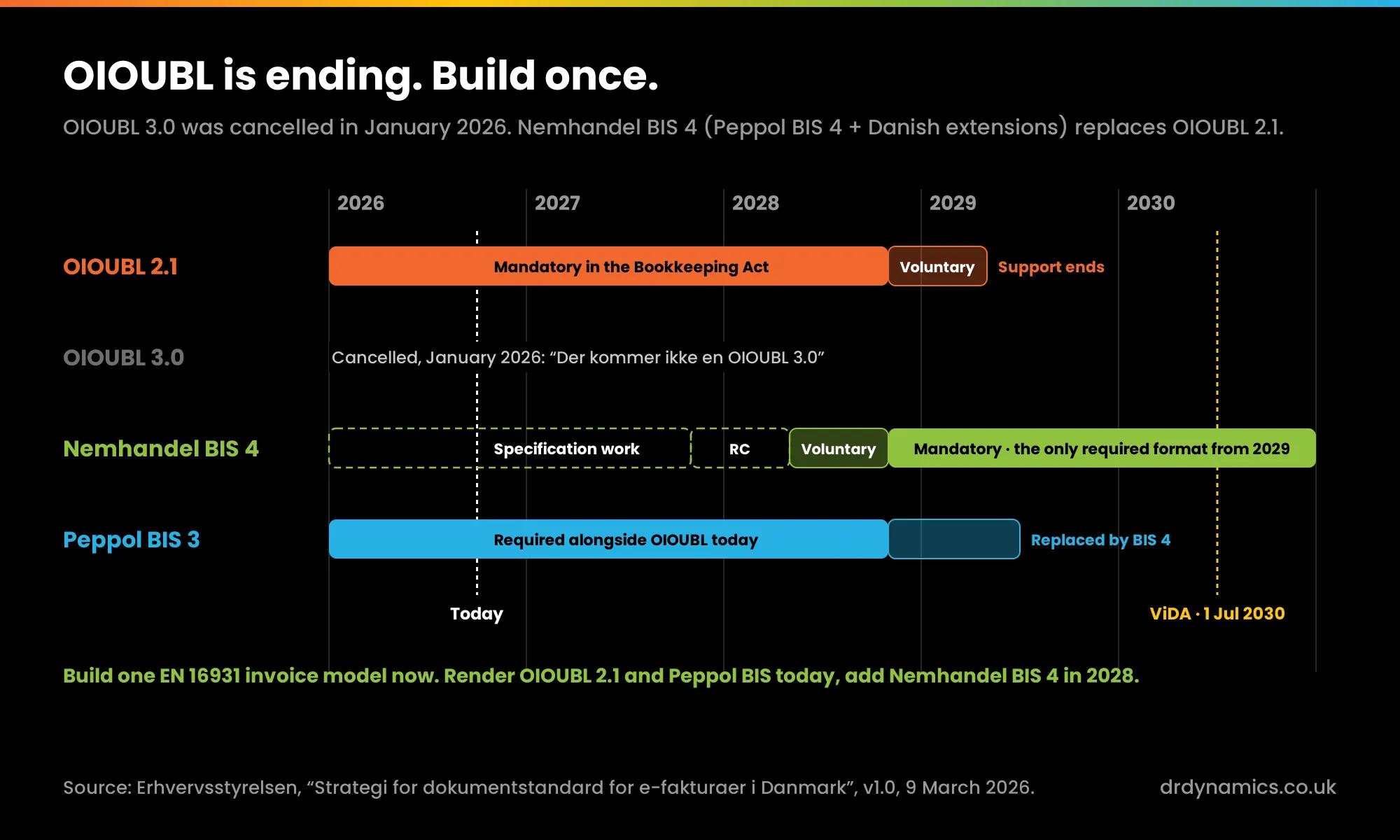
In January 2026 the Danish Business Authority cancelled OIOUBL 3.0 outright (“Der kommer ikke en OIOUBL 3.0”). Its document strategy, published on 9 March 2026, replaces the national format with Nemhandel BIS 4: Peppol BIS 4 with mandatory Danish extensions, built on EN 16931 and the Peppol PINT architecture. Peppol BIS 3 is not the target either.
The published timeline:
- November 2027 to May 2028: release candidate and comment period.
- May to November 2028: phase-in. Nemhandel BIS 4 is voluntary, OIOUBL support is still mandatory.
- November 2028 to May 2029: phase-out. Nemhandel BIS 4 becomes mandatory, OIOUBL 2.1 voluntary, then support ends. Full transition expected by mid-2029.
After the transition, the Bookkeeping Act’s format requirement becomes Nemhandel BIS only.
For an AX project, the consequence is simple: don’t hard-code OIOUBL 2.1 in 2027 only to rip it out in 2028. Build one EN 16931 invoice model inside AX, render OIOUBL 2.1 and Peppol BIS from it today, and add Nemhandel BIS 4 as another output once its specification is final. The data underneath is the same for all three: CVR or GLN endpoints, buyer references, payment means, VAT categories, units of measure. Clean it once.
What Dynamics 365 Finance gives you
Dynamics 365 Finance is the route where Microsoft carries most of the Danish Bookkeeping Act for you, and the coverage is thorough.
It is a registered standard bookkeeping system. The Danish electronic invoice (DK) feature in Microsoft’s Electronic Invoicing service generates OIOUBL and Peppol invoices and credit notes and submits them through the ISV last-mile connector to an e-document delivery provider (Microsoft documents the EDICOM integration). It imports OIOUBL and Peppol vendor invoices into pending vendor invoices, and sends OIOUBL application responses and Peppol message level and invoice responses. SAF-T, VAT submission through the Danish Tax Agency’s API and the NemHandel registration prompt are covered as well.
Microsoft’s documentation adds one caveat worth repeating to any programme board: customising Dynamics 365 Finance can affect its classification as a registered system, and those changes are not covered by the registration. Keep the Danish core standard.
For an AX customer, D365 Finance is the right destination. Getting there is a programme, though, and it will not land before your next audit.
If you are still on AX
For the next two years, the realistic answer is a retrofit.
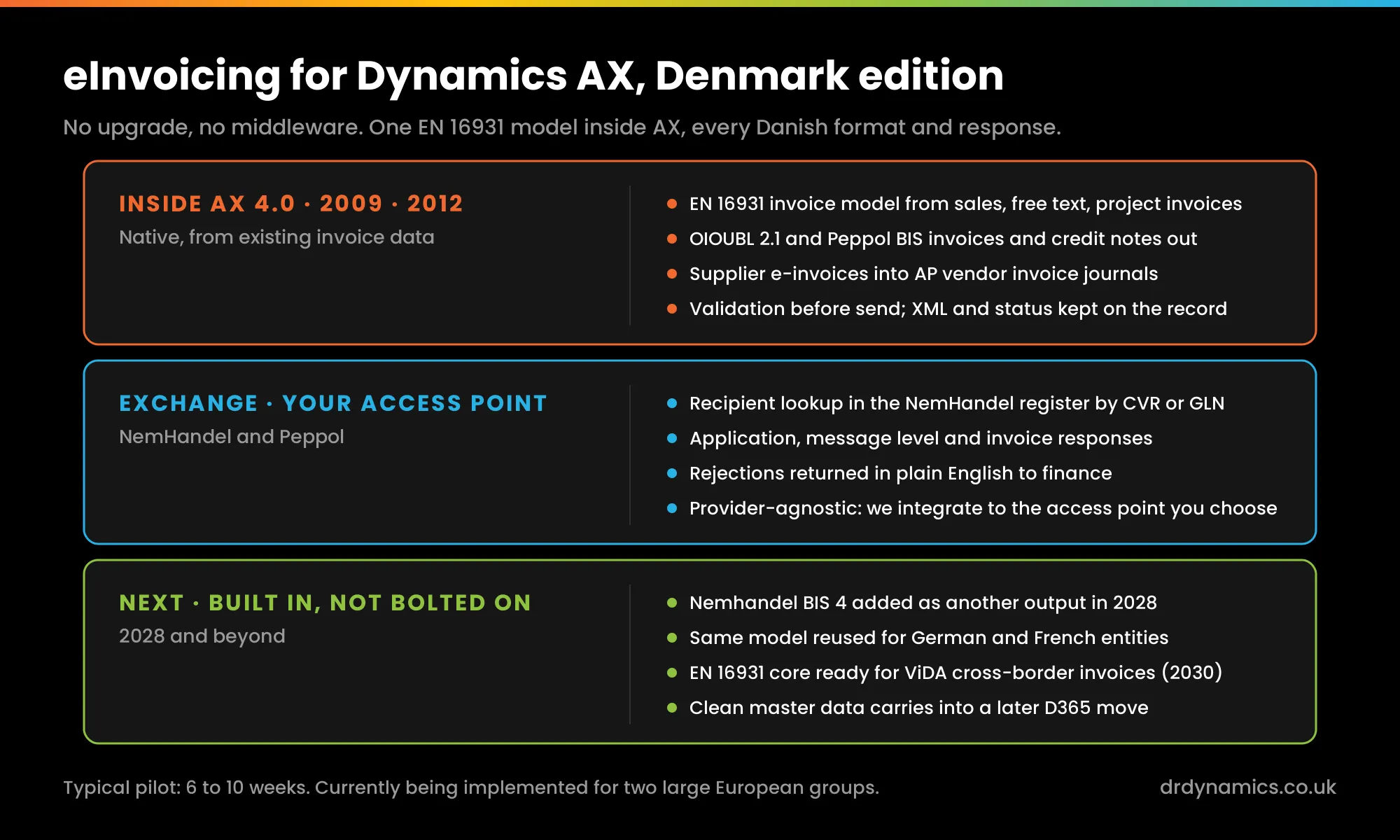
Our eInvoicing for Dynamics AX solution generates structured XML natively inside AX 4.0, AX 2009 and AX 2012, from the invoice data already there. For Denmark that means:
- Outbound: OIOUBL 2.1 and Peppol BIS for sales order, free text and project invoices and credit notes.
- Inbound: supplier e-invoices in OIOUBL and Peppol into AP vendor invoice journals, with the application response, message level response and invoice response sent back.
- Exchange: through the NemHandel and Peppol access point of your choice, with each invoice’s status tracked against the record in AX.
- Next format: one EN 16931 model, so Nemhandel BIS 4 becomes an extra output in 2028, not a rebuild.
No middleware stack, no data duplication, no upgrade. A typical pilot runs six to ten weeks. We are implementing the same AX solution right now for two large European groups.
E-invoicing is only the visible part of Executive Order 205. The weekly off-site backup with an unrelated EU or EEA provider, the SAF-T file and the audit trail on posted entries also land on the company. We include them in the assessment, so your IT team gets one gap list rather than a surprise each quarter.
Denmark is not Germany, and not France
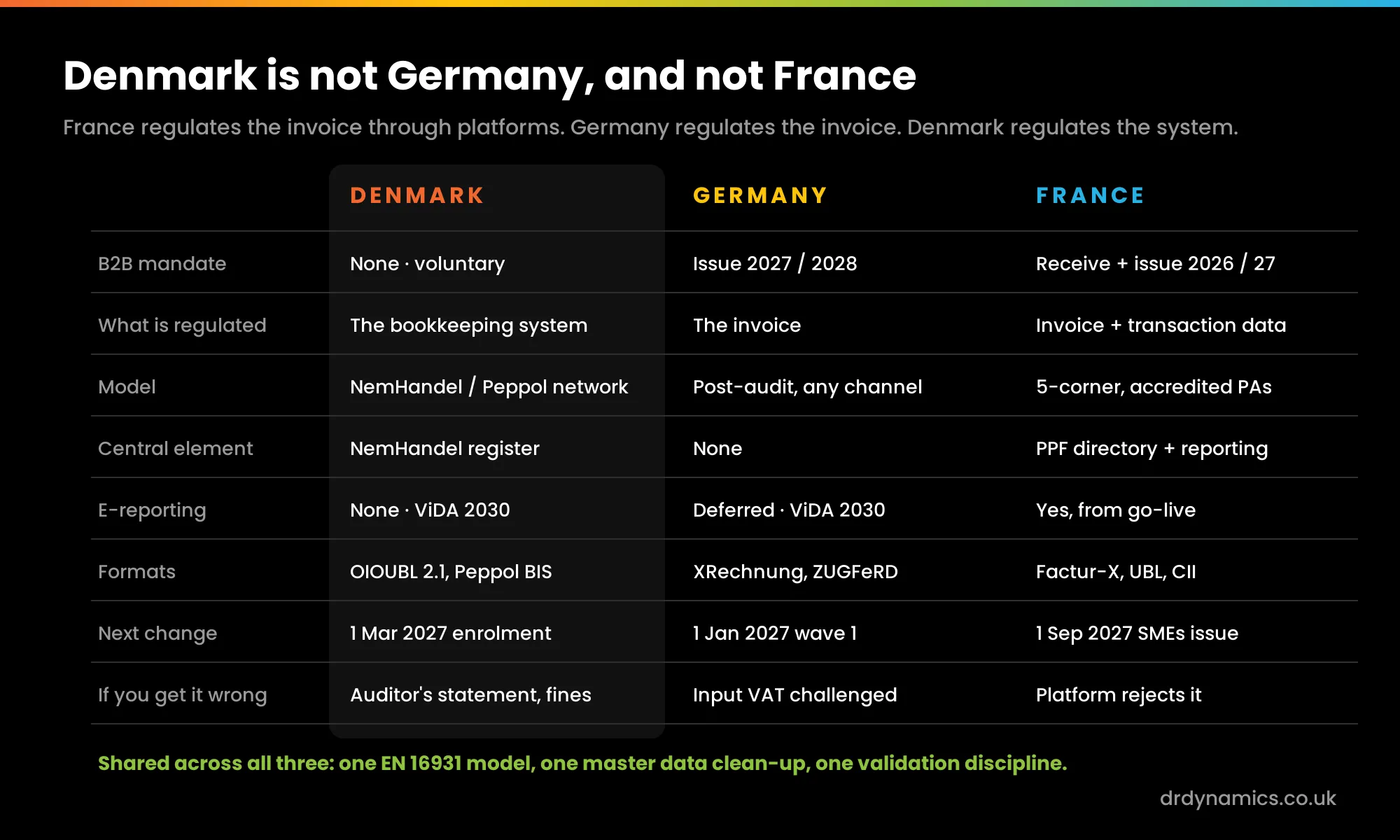
France regulates the invoice through accredited platforms and reports transactions to the state. Germany regulates the invoice and leaves the channel open. Denmark regulates the system and leaves the invoice voluntary.
For a Nordic group with German and French subsidiaries on the same AX core, the work converges. One EN 16931 model, one master data clean-up and one validation discipline serve all three. Only the outputs and the channels differ.
Why now
Denmark has no countdown clock, which is exactly why it slips. Three dates should set your plan anyway.
Your next audit. For calendar-year companies, the FY2026 audit starts in early 2027, and it is the second financial year under Executive Order 205. Auditors are asking about the bookkeeping system.
1 March 2027. Auto-enrolment begins, and structured invoices start arriving in volume from customers and suppliers on registered systems.
2028. Nemhandel BIS 4 phases in. A project that starts now builds the EN 16931 model once and is ready for it. A project that starts in 2028 builds it under two deadlines at the same time.
A six-to-ten-week pilot that begins in November is live before the March enrolment wave.
How we can assist
Dr Dynamics is an independent Dynamics 365 Finance and Operations and AX practice, built by ex-Microsoft FastTrack architects, and e-invoicing is something we do repeatedly: France, Germany, Belgium, Italy, Poland, Norway, and now Denmark. For a Danish AX estate that means a short assessment against Executive Order 205, an access point decision, OIOUBL and Peppol in both directions, the response messages, and a clean path to Nemhandel BIS 4.
The approach is set out on our solution pages: eInvoicing for Dynamics AX and eInvoicing for Dynamics 365 Finance & Operations.
If your Danish entities run AX, the test started in 2025. Book a 30-minute call and we will tell you plainly where your system stands against it.