E-invoicing for Dynamics 365 Finance & Operations. Seamlessly integrated with your provider.
Compliant e-invoicing on standard D365 F&O, built on Electronic Reporting. No add-on licences. Integrates with Pagero, ecosio or your existing provider.
Our e-invoicing solution for Dynamics 365 F&O runs on standard Electronic Reporting — no separate engine, no parallel platform, no extra Microsoft licence. It generates customer invoices in the format each mandate requires (UBL, XRechnung as UBL or CII, ZUGFeRD 2.x / Factur-X), validates them before they leave Dynamics, and exchanges them with your e-invoicing provider, with status updates from the provider and your customer landing back against every invoice. Inbound, the XML your PDP delivers becomes a pending vendor invoice in AP — including France's refuse/reject response when you dispute one. Typically live in 6–10 weeks.
Typically live in 6–10 weeks
1Readiness and architecturecountry footprint, platform choice, scope only the gap
2Configuration and data readinessER formats, provider connection, early master-data check
3Integration and inboundplatform connected, vendor invoices into AP, statuses mapped
4Test, cutover, hypercaresandbox end-to-end, controlled go-live, named contact
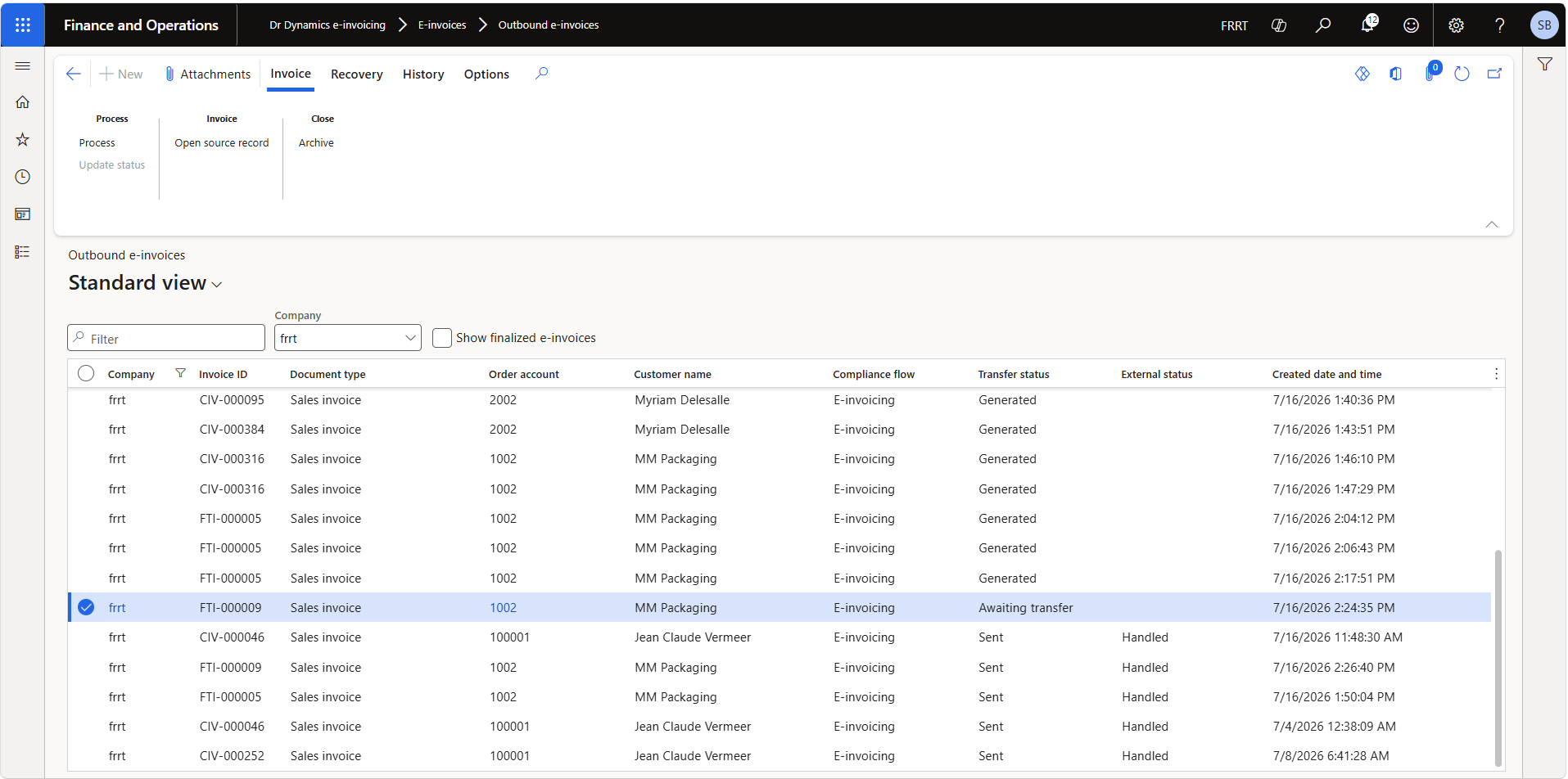
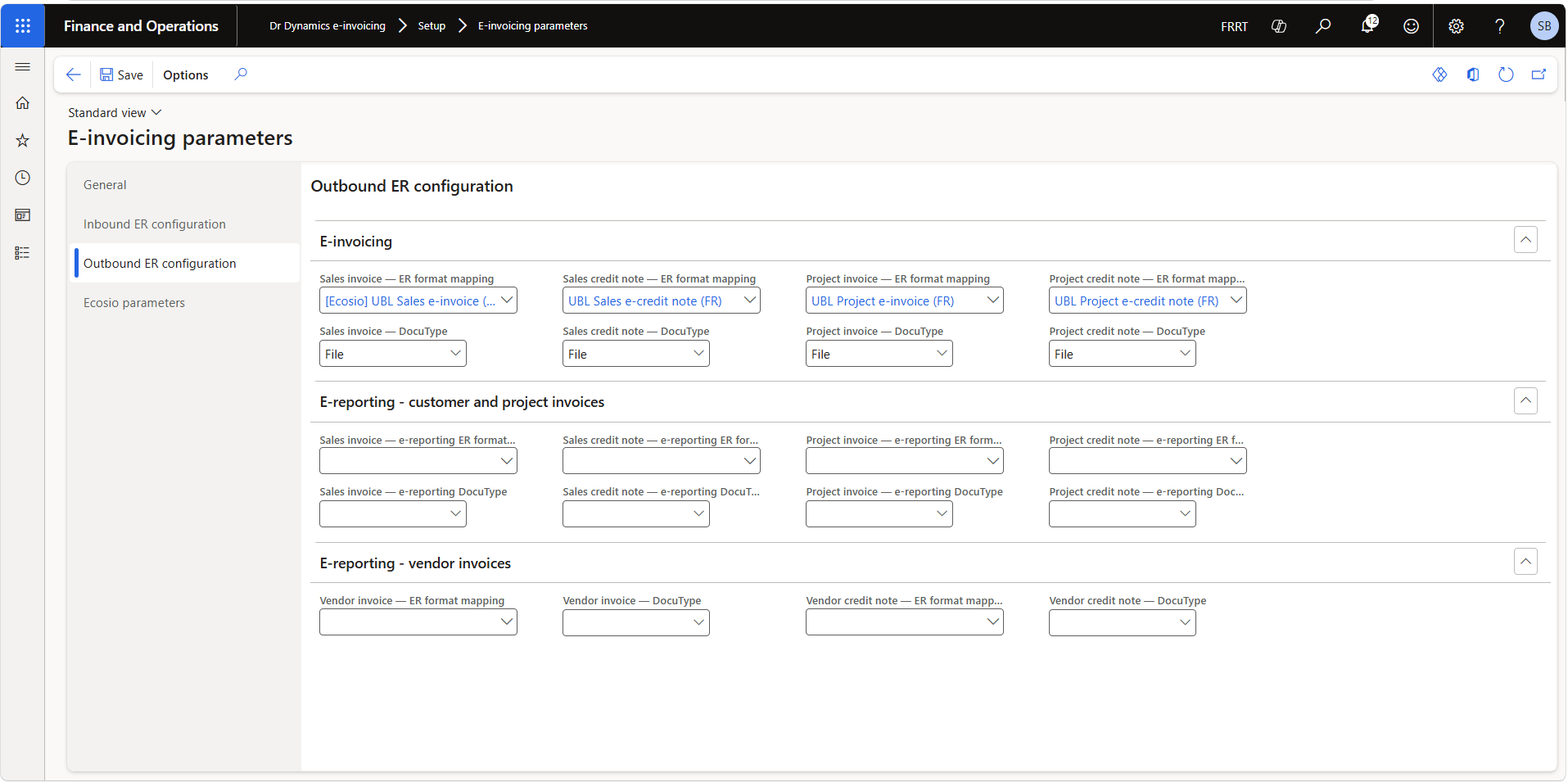
View full size ↗The lifecycle view, inside Dynamics. Every outbound invoice carries its compliance flow and transfer status — Generated, Awaiting transfer, Sent — with the platform's own acknowledgement in the External status column. Finance can filter, open the source record and reprocess without leaving D365. Customer names anonymised.View full size ↗Configuration, not code: outbound ER format mappings set per document type — sales invoice, sales credit note, project invoice, project credit note — against the French UBL profiles, with the platform's own parameters alongside them. Point it at a different provider and the mappings change, not the build.
since 2019ItalySdI live
Jan 2026BelgiumB2B mandatory
Feb–Apr 2026PolandKSeF
1 Sep 2026Francereceive + issue
2027–2028Germanyissuing phased in
Five mandates, one D365 F&O instance — five different deadlines to hit.
Five mandates. One ERP. Five different deadlines.
This stopped being a France problem some time ago. Belgium switched on mandatory structured B2B e-invoicing in January 2026. Poland’s KSeF went live for large taxpayers in February 2026 and for all B2B in April. Italy has run everything through SdI since 2019, and its derogation now runs to the end of 2027. Germany already requires you to receive EN 16931 invoices and is phasing in issuing through 2027 and 2028. France switches on its receive obligation for every established business on 1 September 2026, with large and mid-size companies issuing from the same date.
If you run one D365 F&O instance across several of these countries, you are not managing one mandate. You are managing five calendars, five formats, and five platform relationships, against a single finance system and a single close. That is the job.
The good news is that most of the heavy lifting now sits inside the product.
Standard Electronic Reporting does the generating. We do the connecting.
There is no proprietary engine here — and no extra Microsoft licence. Microsoft’s own route, the Electronic invoicing add-on, is licensed separately on top of D365, metered per document beyond a small monthly allowance. We deliberately avoid it. The solution is built on Electronic Reporting — the standard capability already inside your Dynamics 365 Finance licence — generating your customer invoices in the format each mandate requires: UBL, XRechnung as UBL or CII, ZUGFeRD 2.x / Factur-X. Where Microsoft ships the base format configuration, we build on it; where it doesn’t — the hybrid PDF formats among them — we bring our own. Same compliance, one less subscription.
The part that decides the project is the connection. Dynamics has to exchange documents with your e-invoicing provider — Pagero, ecosio, or whichever platform your group has standardised on — cleanly enough that finance never leaves D365: invoices out, acknowledgements and lifecycle statuses back from the platform and from your customer, rejections visible where AR and AP actually work. That seamless provider integration is the core of what we build.
And it runs both ways. Outbound covers your AR — sales, free text and project invoices — validated against the rulebook before submission. Inbound, the XML your PDP delivers becomes a pending vendor invoice through Electronic Reporting, ready for your existing matching and approval flow. In France, when you do not agree with a supplier invoice, the refuse/reject lifecycle message goes back to the vendor through the same connection.
The work that decides whether you go live
This is the work that stays yours, and the work we do:
Configuring the formats to your reality. The ER formats have to be set up against your document types (sales invoices, free text invoices, project invoices), your tax codes, and the exact country profile. A clean demo tenant is not your tenant.
Connecting your platform. If your group has already standardised on Pagero, Generix, Tradeshift, ecosio, Docaposte or another provider across Europe, that is exactly what we integrate. You pick the platform. We make Dynamics talk to it.
Inbound vendor invoices into AP. Receiving a structured supplier invoice and turning it into a pending vendor invoice your AP team can match and approve is real integration work. It does not configure itself.
Lifecycle statuses finance can act on. Deposited, rejected, refused, cashed. These come back as a stream against every invoice, and they have to land somewhere your finance team can see and act on, with the full audit trail behind them. A “refused” that nobody sees is a compliance gap with a date on it.
Validation before submission, not after. Catch the EN 16931 and country-CIUS errors before the document leaves Dynamics, and you spare finance the send-wait-reject-decode-resend loop. Skip it, and your finance staff spend their week chasing rejected statuses out of a platform portal.
Master data nobody wants to own. SIREN and SIRET, VAT IDs, IBANs, address fields, mandatory tax codes. This is the single biggest cause of rejections, and it has to be fixed before go-live, not during.
Multi-entity rollout on one pattern. Five countries on one D365 instance should be one configuration approach extended five times, not five disconnected projects.
Cutover that holds. Directory and Annuaire registration through your platform, parallel run, hypercare, and a runbook that says who monitors, who fixes, and who reprocesses at 5pm on a Friday.
You’re in the right place if…
You run Dynamics 365 Finance & Operations and trade in France, Germany, Belgium, Italy, Poland or another EN 16931 country
You want to build on standard Microsoft functionality, not bolt on a parallel platform that fights your upgrades
You have already chosen a Peppol or PDP provider, or want help shortlisting one against your volumes and geographies
Your auditors will ask awkward questions if the XML, the lifecycle statuses and the audit trail do not line up
You are running this across multiple legal entities and need one approach, not five
What we add on top of standard D365
A built-in pre-submission validator. Every outbound invoice is checked against the EN 16931 ruleset and the country CIUS before it leaves Dynamics. Fewer rejections, less finance firefighting.
Platform-agnostic by design. EDICOM, Pagero, Generix, Tradeshift, ecosio, Docaposte and others. You choose. Switching later costs a configuration pack, not a rebuild.
Inbound AP, properly wired. Structured supplier invoices land as pending vendor invoices, ready for your existing matching and approval flow — and in France, refuse/reject goes back to the supplier when you dispute an invoice.
A lifecycle status view that earns its place. Sent, accepted, rejected, refused, cashed, tracked against the source invoice, visible to finance, reprocessable from Dynamics.
Audit trail ready. Generated XMLs and status history stored against the invoice record. Auditors get what they need without a ticket.
Standard wherever standard reaches. Built on Electronic Reporting, with a lean extension only where standard stops — the provider connection and the lifecycle view. Wave updates land the way Microsoft intends. Your team doesn’t carry a fork.
One pattern, every entity. Built to extend across your country footprint on a single, repeatable configuration.
Fast to pilot. Typical pilot in 6 to 10 weeks, depending on country count and data readiness.
Where it works today
Country
Mandate status (June 2026)
How we deliver it
France
Receive for all from 1 Sep 2026; issue for large and mid-size from 1 Sep 2026; SMEs from 1 Sep 2027
ER formats (UBL / Factur-X) to your PDP; pre-submission validation; lifecycle statuses including refuse/reject
Germany
EN 16931 receiving in force since Jan 2025; issuing phases in through 2027 and 2028
XRechnung (UBL or CII) and ZUGFeRD 2.x via ER; we configure and operationalise
Belgium
Mandatory structured B2B e-invoicing since 1 Jan 2026 (Peppol)
Peppol BIS via your access point; we configure and connect
Italy
SdI mandatory since 2019; EU derogation runs to 31 Dec 2027
Through your provider’s certified SdI connection; we configure the D365 side
Poland
KSeF mandatory from 1 Feb 2026 (large taxpayers) and 1 Apr 2026 (all B2B); micro from Jan 2027
Through your provider’s certified KSeF connection; we configure the D365 side
Other EN 16931 countries
On request
Available
Dates reflect published mandates as of June 2026. We re-baseline these with you as authorities confirm them.
The French flow model at a glance
A consolidated reference for the French flows Dynamics has to satisfy — the same PPF/PDP model the configuration work above targets. Keep it beside your scoping notes.
Your platformPA-e
F2 the invoice — UBL / CII / Factur-X via Peppol→←F6 Deposited / Rejected / Refused / Cashed
Your customer's platformPA-r
↓F1 regulatory data · F10 e-reporting (B2C / cross-border / payment data)⇅F13 · F14 Annuaire updates and routing queries
PPFData Concentrator
1 Sep 2026 — receive obligation for all; issue for large + mid-size · EN 16931 formats only · 10-year archive
E-invoicing flows
F1 — Regulatory data (PA-e → PPF Data Concentrator); F2 — the invoice (PA-e → PA-r; UBL / CII / Factur-X via Peppol); F6 — lifecycle statuses (Deposited / Rejected / Refused / Cashed).
1 Sep 2026 — receive obligation for all; issue obligation for large + mid-size; 10-year archive; EN 16931 formats only.
It’s a data and exception problem, not a format problem
Most e-invoicing projects go sideways for the same reason. Teams scope them as a format conversion exercise. Generate the XML, post it, store the receipt, done. It is never that. The hard parts are data quality, exception handling, and who owns the rejection that lands at 5pm on a Friday.
Standard Dynamics will happily generate a perfectly valid XML from invalid master data and watch it get refused downstream. The format was fine. The SIRET was wrong.
We build for those realities.
Minimal disruption to your posting and approval workflows.
Batch-friendly processing with retries.
Rejection feedback in plain English, so finance can fix the invoice without opening a platform portal or raising a ticket.
Validation that runs before submission, because the cheapest rejection is the one that never reaches your provider.
From standard feature to live across your estate, in four phases
1Readiness and architecture.Country footprint, document types, volumes, platform choice, target operating model. We confirm what standard Dynamics covers for each country and scope only the gap. Usually a week or two.
2Configuration and data readiness.We configure the ER formats and the provider connection, and run the master-data check early: VAT IDs, SIREN and SIRET, IBANs, address fields, mandatory tax codes. You fix the data while we build.
3Integration and inbound.Connect your chosen platform, wire inbound vendor invoices into AP, and map the lifecycle statuses into a view finance can act on, with audit trail.
4Test, cutover, hypercare.End-to-end against your platform's sandbox with real invoice patterns. Controlled go-live with a runbook. Then handover, documentation, and a named contact for escalations.
Proof, not a pitch deck
We have built and now operate a Dynamics e-invoicing solution that spans the full version range, from D365 Finance & Operations back through legacy AX. On D365 F&O it runs on standard Electronic Reporting. For legacy AX, where Microsoft never delivered that capability, it provides the equivalent extraction and outbound layer. Same flows, same format compliance, same lifecycle handling.
We are already live on real readiness work, including a multi-entity European group running D365 Finance & Operations across several mandate countries on a single configuration pattern, and recovery engagements where a stalled implementation needed a finance-architect-led reset. The solution is tested in production conditions, not against a spec sheet.
And we are independent. When we tell you to build on what Microsoft ships, we are not quietly selling you a platform licence on the side.
Who is building this
Dr Dynamics is an independent Microsoft Dynamics 365 Finance & Operations consultancy based in the UK. E-invoicing is our core specialism — it is what we build, implement and support. The team includes ex-Microsoft engineers, ex-FastTrack Solution Architects, and ex-Microsoft localisation programme managers. We have worked on AX and D365 F&O projects at EY, Deloitte, Credit Suisse, Starbucks, HPE, Somerset Council and Notting Hill Genesis, among others.
Our 34-check data-readiness validator: a code package your engineer drops into D365 Finance, so your team can run the seller, buyer and payment-terms checks on your own master data — and get a plain-Excel report of every problem and its fix. Email [email protected] to get it.
Implement from €35,000
Full implementation: configuration, platform connection, inbound AP, the validation layer, master-data checks and cutover. Typical pilot live in 6–10 weeks.
Run Support at 15% per year
Post-go-live support with a named engineer, an SLA and a monthly operational review — so the next mandate is a configuration task, not a project.
Start free → Validate the data behind your e-invoices.Our readiness validator runs 34 checks — seller, buyer and payment terms — inside Dynamics 365 Finance, on your own master data, and reports every problem and its fix in a plain Excel list. The actual package, not a demo: email [email protected] with subject “READINESS” and we'll send it over.
A lot of it, and we build on it rather than around it. Standard Electronic Reporting — part of the licence you already own — is the engine: Microsoft ships the base format configurations, and we extend them where standard stops, including ZUGFeRD and Factur-X. What standard does not do for you is the seamless connection to your provider, inbound AP, the lifecycle view your finance team needs, pre-submission validation, and the master-data and cutover work. That is the part we do.
Don't we need Microsoft's Electronic invoicing add-on?
No — avoiding it is a design goal. The add-on is licensed separately, with per-document capacity beyond a small monthly allowance. Our solution runs on standard Electronic Reporting, which is part of the D365 F&O licence you already own, and connects Dynamics directly to your e-invoicing provider. You pay Microsoft nothing extra for e-invoicing.
We've already standardised on a platform. Is that a problem?
No — that is the design centre. If your group runs Pagero, Generix, Tradeshift, ecosio, Docaposte or another platform, we configure Dynamics to talk to it. Switching later is configuration, not a rebuild.
We only need one country. Do we pay for all of them?
No. The approach is modular. Configure the countries you need now, extend to others when their mandates land.
What about our auditors?
Full audit trail, generated XMLs stored against the invoice record, status history preserved. No drama.
Will this slow down our other D365 work?
It shouldn't. The solution runs on standard Electronic Reporting, so Wave updates land cleanly, and we scope the e-invoicing work as its own controlled stream with its own cutover.
Can you support us after go-live?
Yes. Support arrangement with a named engineer, an SLA, and a monthly operational review. Separate SOW.
Is it on Microsoft Marketplace?
Yes. It is listed as Dr Dynamics – Electronic Invoicing Connector, for Dynamics 365 Finance, Supply Chain Management and Project Operations. The listing is the product reference; implementation is scoped with you on a call.
Does it work on-premises?
Microsoft's Electronic invoicing add-on doesn't support on-premises deployments at all — and our solution doesn't depend on it. The standard solution we deliver applies to cloud D365 Finance & Operations. For on-premises or legacy AX estates, we deliver the equivalent layer as a consulting engagement.
Germany's B2B e-invoicing mandate starts 1 January 2027 above EUR 800,000 turnover. No platform, no clearance. What D365 F&O and AX teams must do in 2026.
France's public invoicing portal stops accepting file transfers from 13:00 CEST on 10 September 2026. What stops, what keeps running, what DGFiP expects.
Tell it where your entities are. It returns which European e-invoicing mandates apply, when each starts, and what that means in D365 F&O. Free, no sign-up.
Get your fastest-path plan
Bring your country footprint, your Dynamics version and whichever mandate date is closest. We'll come back with a one-page fastest-path plan within 48 hours.