In brief
Norway passed its B2B e-invoicing law in June 2026, while everyone was watching France's countdown. From 1 January 2027, bookkeeping-obligated businesses must issue structured e-invoices to each other; by 1 January 2030 they must run digital bookkeeping and be able to receive and process e-invoices automatically. The model is the lightest in Europe: EHF over the Peppol network, no government platform, no clearance, no e-reporting of transactions. That makes the project smaller than a French one, but the deadline is closer than most Nordic finance teams think — and it lands on the same day as Norway's SAF-T v1.40 requirement.
While Europe watched France count down to September, Norway turned B2B e-invoicing into law with barely a headline. The Storting adopted the amendments to the Bookkeeping Act on 8 June 2026, the law was sanctioned on 19 June, and the first obligation bites on 1 January 2027. Five months from now.
If your group runs Norwegian entities on D365 F&O, this one is very manageable. It is also very easy to leave too late, because the Norwegian mandate looks so light that it keeps falling off programme boards. Here is the briefing I’d want every CFO and CIO with Nordic operations to have on one page.
What Norway actually decided
The law creates two obligations, three years apart.
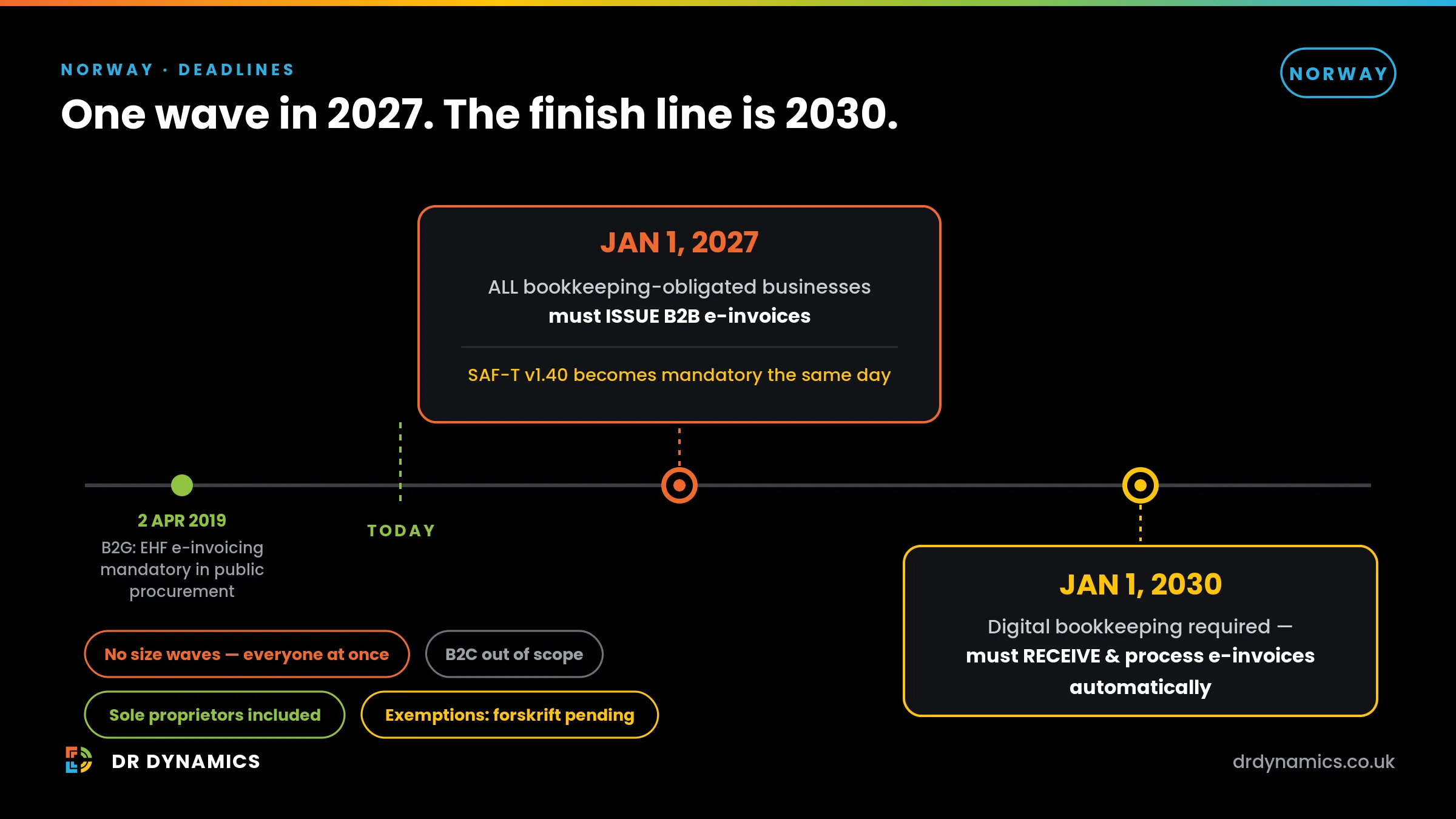
From 1 January 2027, bookkeeping-obligated businesses must issue e-invoices when they invoice other businesses. That covers limited companies, state enterprises, financial undertakings, housing associations, foundations — and sole proprietorships. This is not a large-companies-first rollout like France or Germany. One wave, everyone at once.
From 1 January 2030, the same businesses must run digital bookkeeping: an accounting system that, among other things, receives and processes e-invoices automatically. The Ministry of Finance has confirmed transitional rules meaning the obligation to receive e-invoices must be met by that date.
Two details worth knowing. First, the issuing date moved. The 2025 consultation proposed 2028; in March 2026 the government pulled it forward a full year to 2027, and Parliament kept that date. Plenty of advisory pages still say 2028 — they’re stale. Second, the fine print isn’t finished: Skattedirektoratet will set the approved formats and the exemptions in regulations. The consultation proposed exempting businesses under NOK 50,000 turnover with no accounts or VAT obligation, but until the forskrift lands, treat the exemption list as pending.
B2C invoicing is out of scope. B2G has been covered since April 2019, when Norway made EHF e-invoicing mandatory in public procurement. And there’s a signal worth filing: Skattedirektoratet has been asked to investigate extending the regime to B2C invoicing, digital receipts and regulation of accounting-system providers, reporting back in December 2026. Norway is building this in layers.
The government’s own case for the reform is blunt: an estimated NOK 10 billion in savings for the business community over 20 years, most of it from the issuing requirement, plus a harder environment for invoice fraud and economic crime.
The lightest mandate in Europe
Norway chose the opposite of a clearance model. No government platform sits in the invoice flow. No certified-provider regime like France’s PDPs. No transaction data flowing to the tax authority when you invoice a customer.
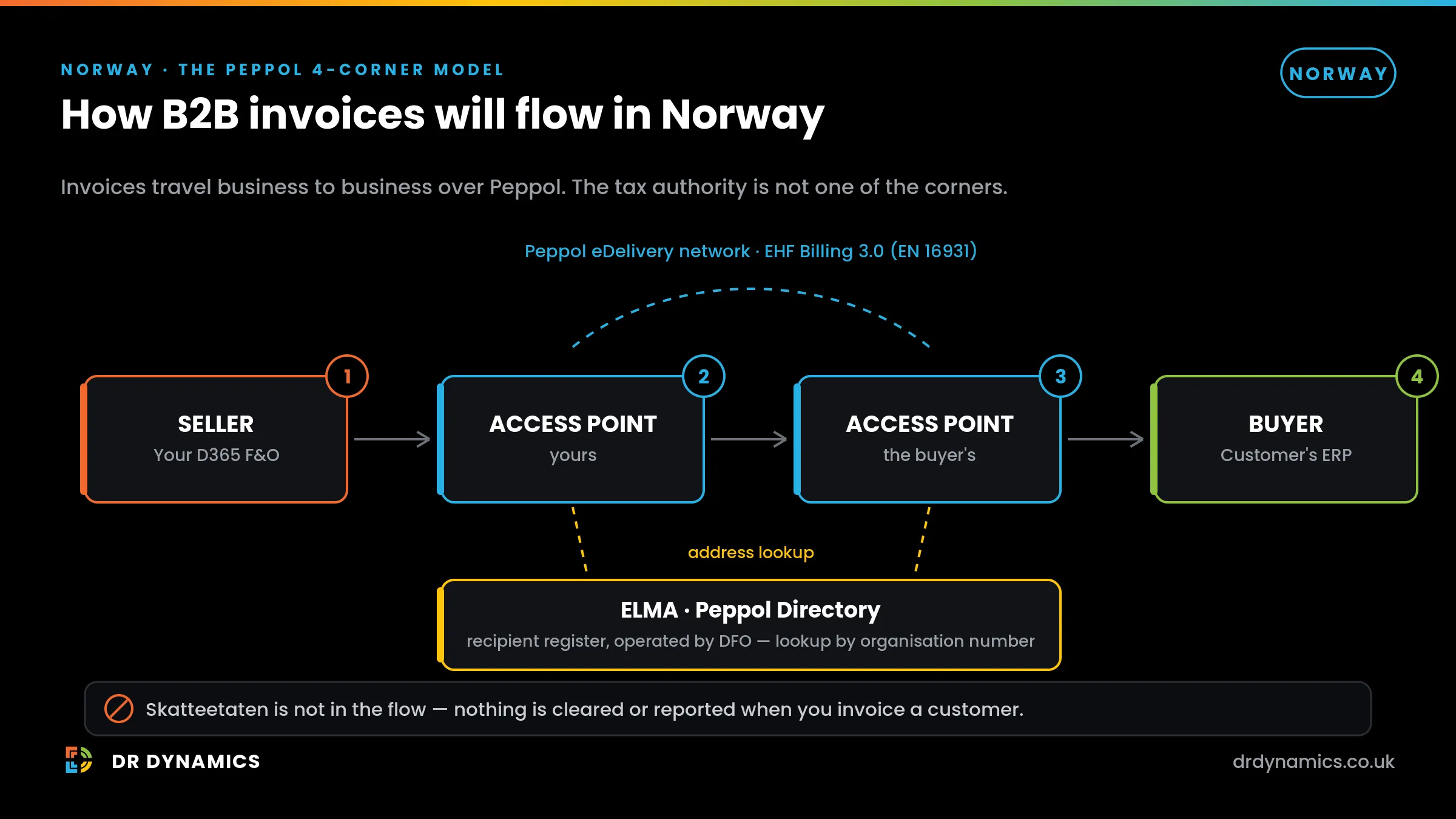
The expected mechanics are the ones Norwegian public-sector suppliers have used for years: EHF Billing 3.0 — Norway’s application of Peppol BIS Billing 3.0, which implements the European EN 16931 standard — exchanged over the Peppol network through access points. Recipients are found via the ELMA register (now surfaced through the Peppol Directory), operated by DFØ, which also serves as Norway’s Peppol Authority. Four corners: your ERP, your access point, your customer’s access point, your customer’s ERP. The tax authority isn’t one of them.
One honest caveat: the format regulation is still with Skattedirektoratet. Everything points to EHF over Peppol — it’s the installed base, it’s what the consultation built on — but I wouldn’t put “EHF is the legally mandated format” in a board paper until the forskrift is published. What you can put in a board paper: whatever the forskrift says, it will be EN 16931-shaped, and Peppol connectivity will not be wasted work.
What Skatteetaten actually sees
This is where Norway differs most sharply from the direction of travel in the EU — and it’s the part I find CFOs get wrong most often.
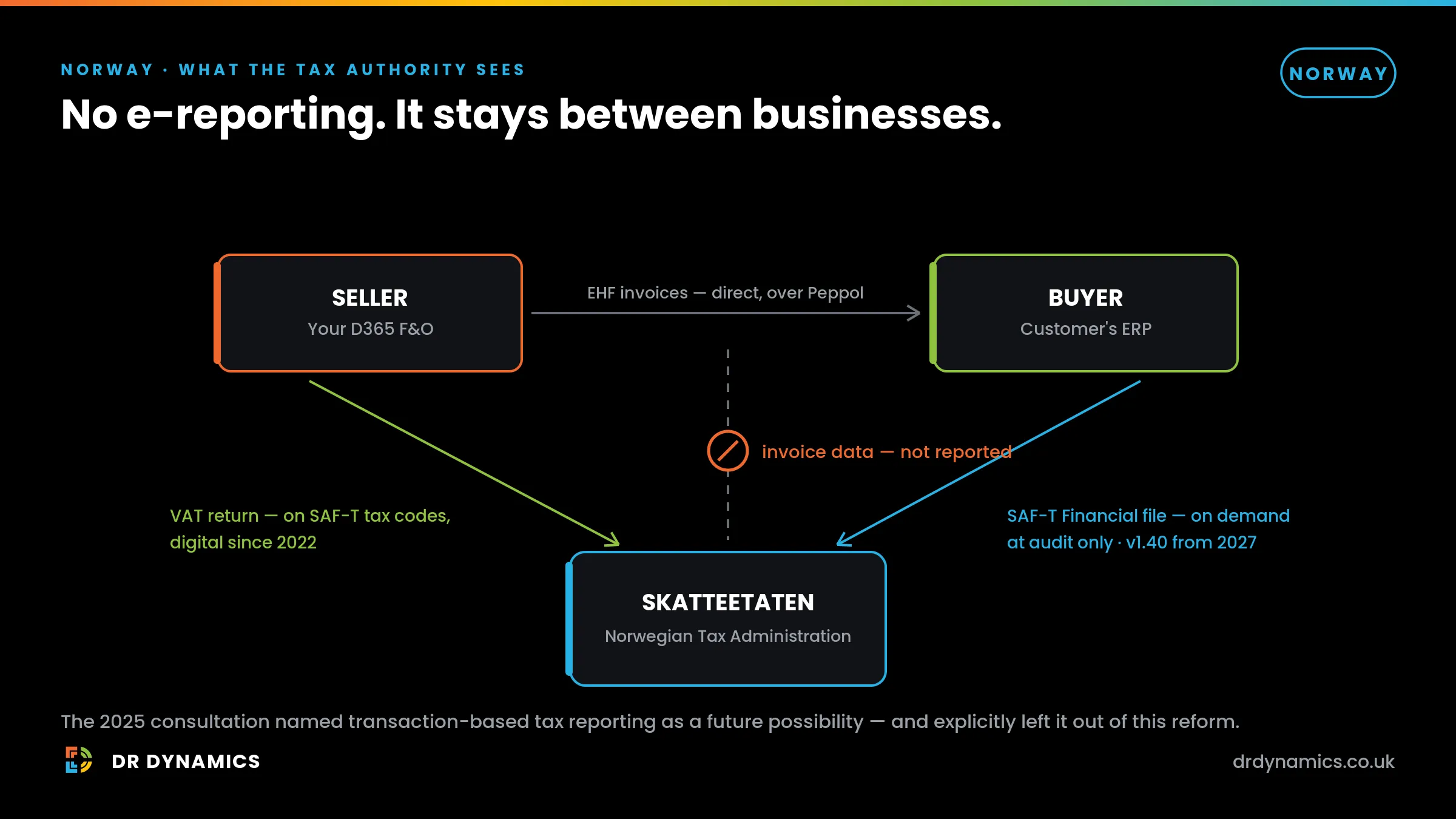
Norway already has a mature digital reporting stack, and none of it is transaction-by-transaction. SAF-T Financial has been required since 2020, but only on demand — you produce the file when Skatteetaten audits you, not on a filing calendar. The VAT return has been structured on SAF-T tax codes since 2022, submitted digitally and ideally straight from the ERP. That’s it. No real-time invoice reporting, no clearance, no lifecycle statuses.
The consultation even said the quiet part out loud: it named transaction-based tax reporting as a possibility the reform could pave the way for, then explicitly kept it out of scope. Norway isn’t an EU member, ViDA doesn’t bind it, and there is currently no Norwegian equivalent of France’s e-reporting flows on any legislative track. Plan for the mandate that exists, note the direction, and don’t build a CTC programme nobody has asked for.
One date deserves a red circle, though: SAF-T v1.40 becomes mandatory for financial years starting 1 January 2027 — the same day the e-invoicing obligation starts. Two compliance changes, one go-live window. If your Norwegian entities’ SAF-T export hasn’t been touched since 2020, you now have two reasons to open it.
Who must do what
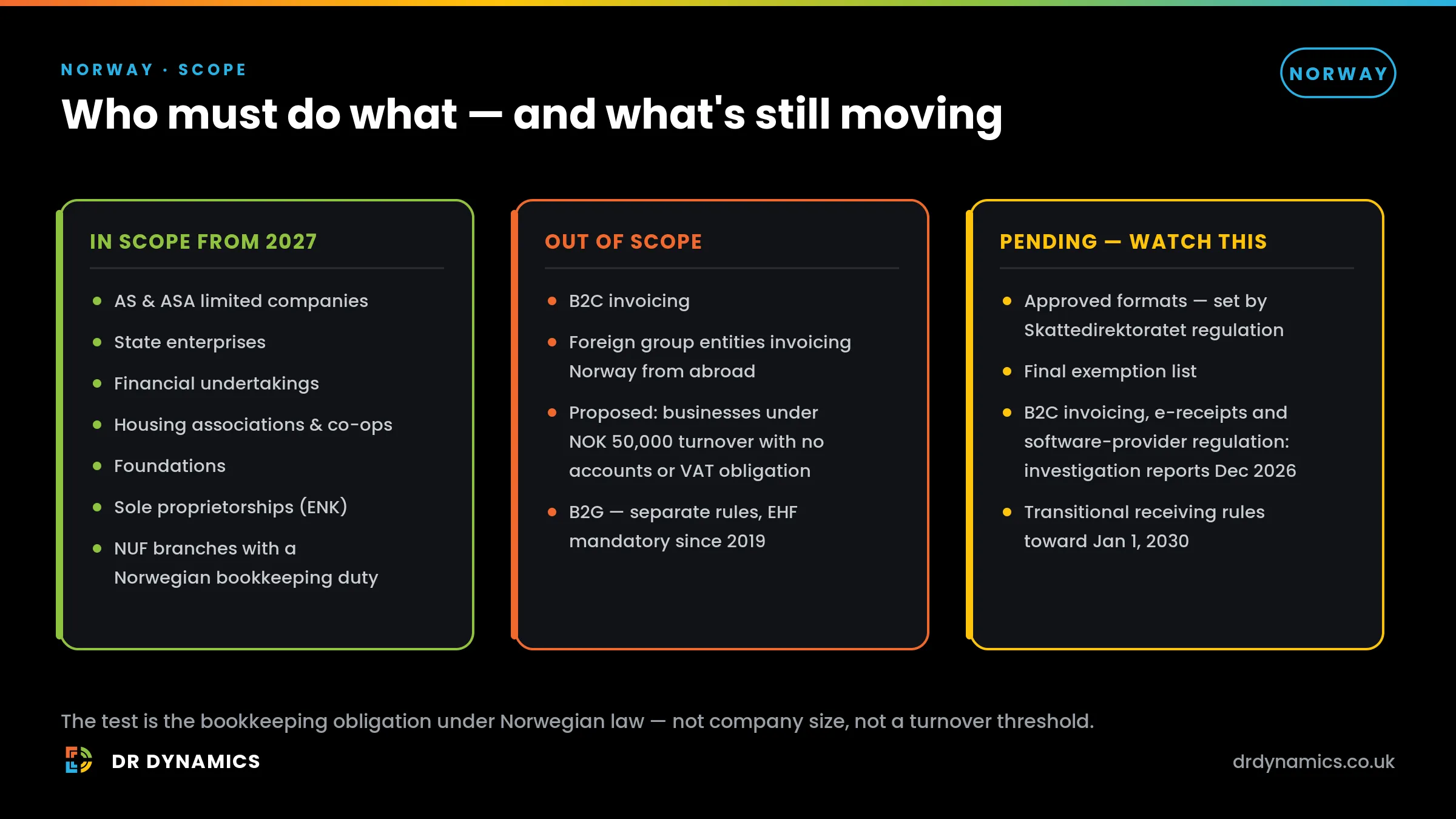
The test is bookkeeping obligation under Norwegian law, not company size and not a turnover threshold. If the entity keeps books under the bokføringsloven, it issues e-invoices to business customers from 2027 and receives them digitally by 2030. Foreign entities with a Norwegian bookkeeping obligation — typically branches (NUF) registered in Norway — should assume they’re in scope and get specific advice, because the exemption regulation is the piece still moving.
And to be clear about what this is not: there is no obligation on your foreign group entities to e-invoice their Norwegian customers from abroad. This is a domestic bookkeeping-law obligation, not a VAT-registration dragnet like France’s.
Norway vs France: same standard, opposite philosophy
If you read our France and Germany briefing, the contrast is useful because it sizes the project.
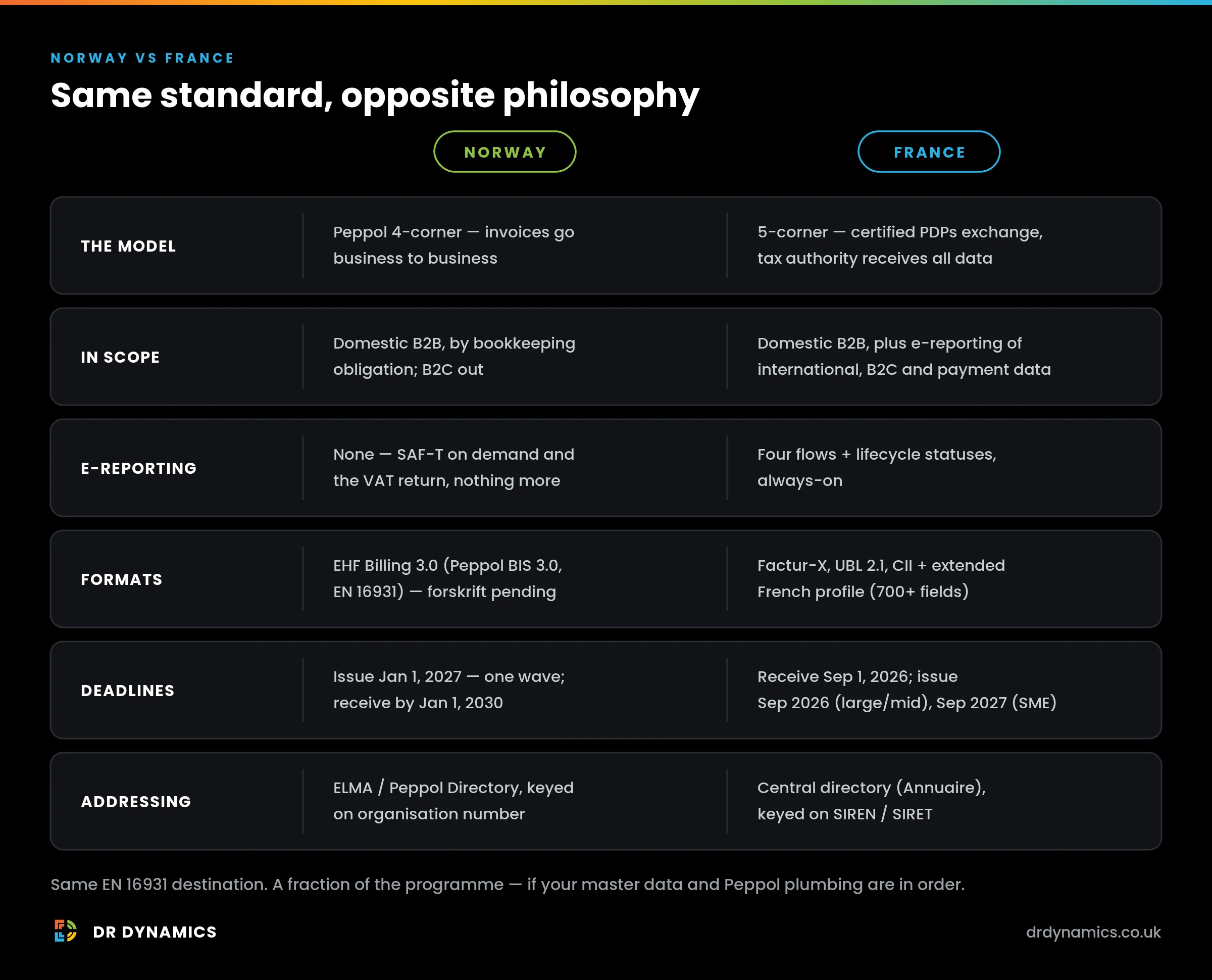
France gives you certified platforms, a central directory, four e-reporting flows and lifecycle statuses — a compliance and integration programme with a steering committee. Norway gives you a format, a network you may already be connected to, and two dates. The destination is the same EN 16931 structured invoice. The effort is a fraction — if your master data and your Peppol plumbing are in order.
That’s the trap. Because the mandate looks small, it gets no budget line, and then a Nordic entity spends December 2026 discovering that its customer master has no organisation numbers, its access-point contract covers B2G only, and its EHF setup was configured once in 2019 by someone who left.
What to do now if you run D365 F&O
The good news: D365 Finance already speaks Norwegian. Microsoft’s localisation for Norway generates EHF Billing 3.0 customer invoices through Electronic Reporting — the feature is “Customer electronic invoices in Norway” — and there’s a country-independent Peppol BIS 3 capability in the Electronic invoicing service. Generation is the solved part. Transmission is yours: Microsoft doesn’t act as your access point, so the Peppol leg is a provider decision.
The checklist I’m running with clients:
- Inventory the Norwegian entities. Which ones have a bookkeeping obligation, which ones issue B2B invoices, which volumes. Include NUF branches.
- Contract or extend a Peppol access point and register every issuing and receiving entity in ELMA. If you already send EHF to public-sector customers, this is an amendment, not a procurement.
- Switch on and test EHF issuing from F&O — ER configurations current, organisation numbers and VAT numbers clean on the legal entity, customer e-invoice flags set, unit codes and tax category mappings done. Organisation numbers on the customer master are your longest lead-time item; they’re the Peppol address key.
- Move SAF-T to v1.40 for FY2027 and retest the export end to end.
- Plan the 2030 AP side now, casually. Automatic receipt and processing of e-invoices is the 2030 obligation; it’s also just good AP automation with a three-year runway. Entities receiving EHF today into a PDF-based AP process should start there.
- Run a real test cycle in 2026 — an EHF invoice into a pilot customer, a received EHF into your AP flow. An invoice your customer’s access point rejects on 2 January 2027 is a cash-flow incident, not an IT ticket.
Where Norway fits in the European picture
Norway’s timing is not an outlier — it’s the pattern. Italy has run clearance since 2019. Poland, Belgium, Croatia and Greece switched on in 2026. France goes in September. Germany, Slovakia, Norway and Spain’s first wave issue from 2027; Latvia, Slovenia and Ireland follow in 2028, and ViDA makes structured e-invoicing and digital reporting the rule for intra-EU trade from July 2030. Every one of these has its own format profile, model and calendar — and the map below is why “we’ll handle e-invoicing country by country as it comes” stops being a strategy.
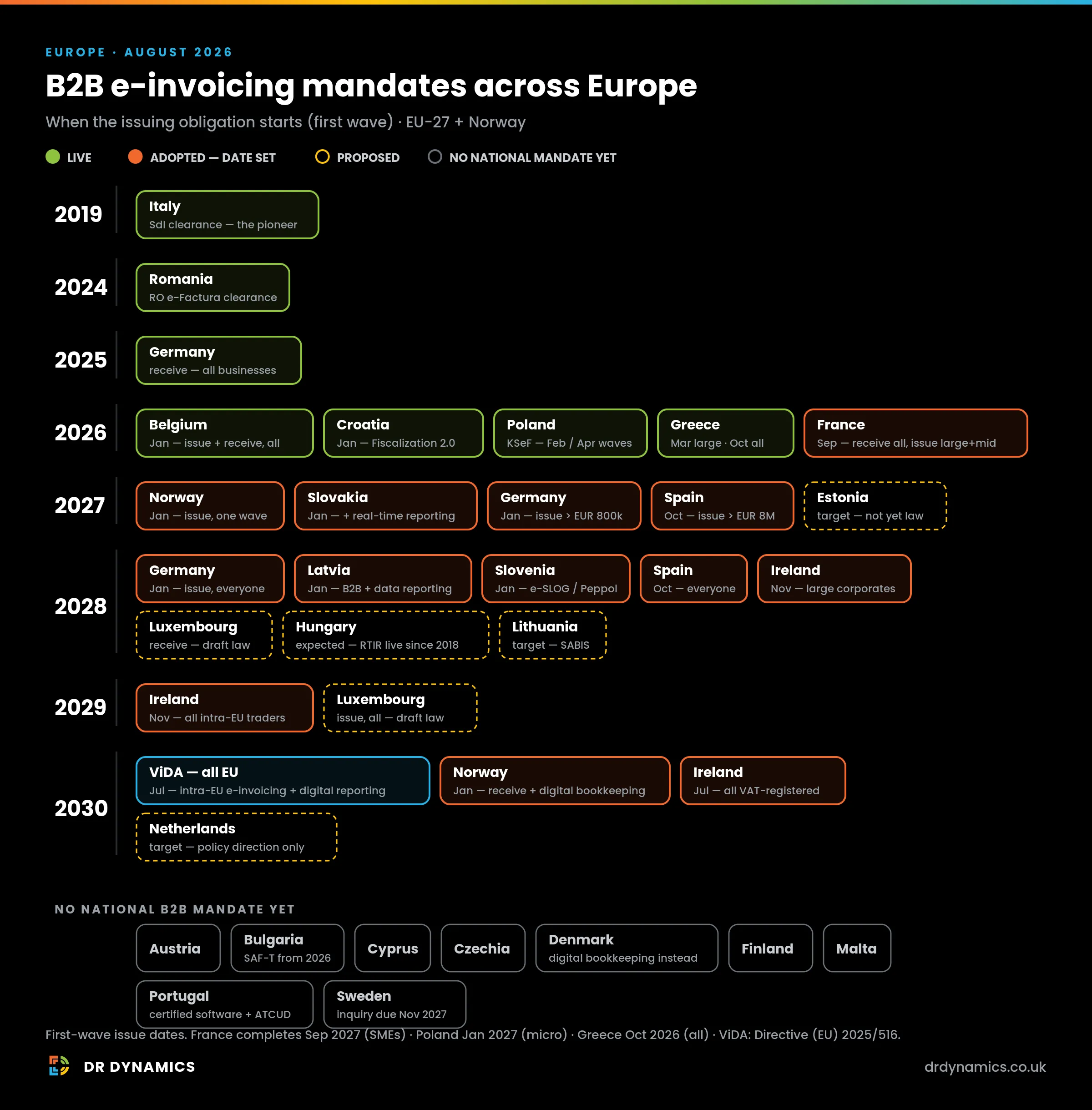
If your group trades in more than two of these countries, the cheapest decision you can make in 2026 is a modular invoice architecture: one EN 16931-capable generation layer in D365 F&O, one archiving approach, country plugins on top. We made that argument in detail here.
How we can assist
Dr Dynamics helps D365 F&O organisations get through exactly this. For Norway that means an impact check against your current F&O configuration, EHF and Peppol setup and testing, access-point selection, SAF-T v1.40, and an AP intake design that will satisfy the 2030 digital bookkeeping requirement without a second project. The approach and architecture are described on our solution page: eInvoicing for Dynamics 365 F&O.
The Norwegian mandate has no waves to hide behind: one date, everyone at once. Get in touch and we’ll tell you, honestly, how much runway you have left.