In brief
France switches on the most ambitious e-invoicing mandate in Europe on 1 September 2026 — every company must be able to receive via a certified platform (PDP), large companies and mid-caps must issue, and e-reporting covers everything else; SMEs follow in 2027. Germany has required receiving since January 2025 and phases issuing in through 2027–28, with no platforms and no government portal. Same EN 16931 destination, opposite operating models: France is a compliance and integration programme, Germany an AP-automation and master-data exercise. The shared foundation — clean master data, EN 16931-capable invoice generation from D365 F&O, structured archiving — is worth building once.
If your group invoices customers in France or Germany, two of Europe’s largest e-invoicing mandates are about to change how your ERP talks to your customers, your suppliers and — in France’s case — the tax authority itself.
The dates are not comfortable. France’s first wave lands on September 1, 2026 — weeks away. Germany’s receiving obligation has been law since January 2025, and its issuing obligation starts in 2027.
I’ve spent the last months helping D365 F&O clients get ready for both. Here is the executive summary I wish every CFO and CIO had on one page: what each country actually requires, how the two mandates differ, and where the real project effort sits.
France: not just e-invoicing — a full transaction surveillance model
France is building the most ambitious mandate in Europe. It has three pillars: e-invoicing (structured invoices for domestic B2B), e-reporting (transaction and payment data for everything else), and lifecycle reporting (statuses such as rejected, approved, paid flowing back to the tax authority).
The 5-corner model
Invoices stop travelling directly from supplier to customer. Every domestic B2B invoice must pass through certified platforms — Plateformes de Dématérialisation Partenaires (PDPs). Your PDP talks to your customer’s PDP, and both report the data to the PPF, the public portal run by the DGFiP.
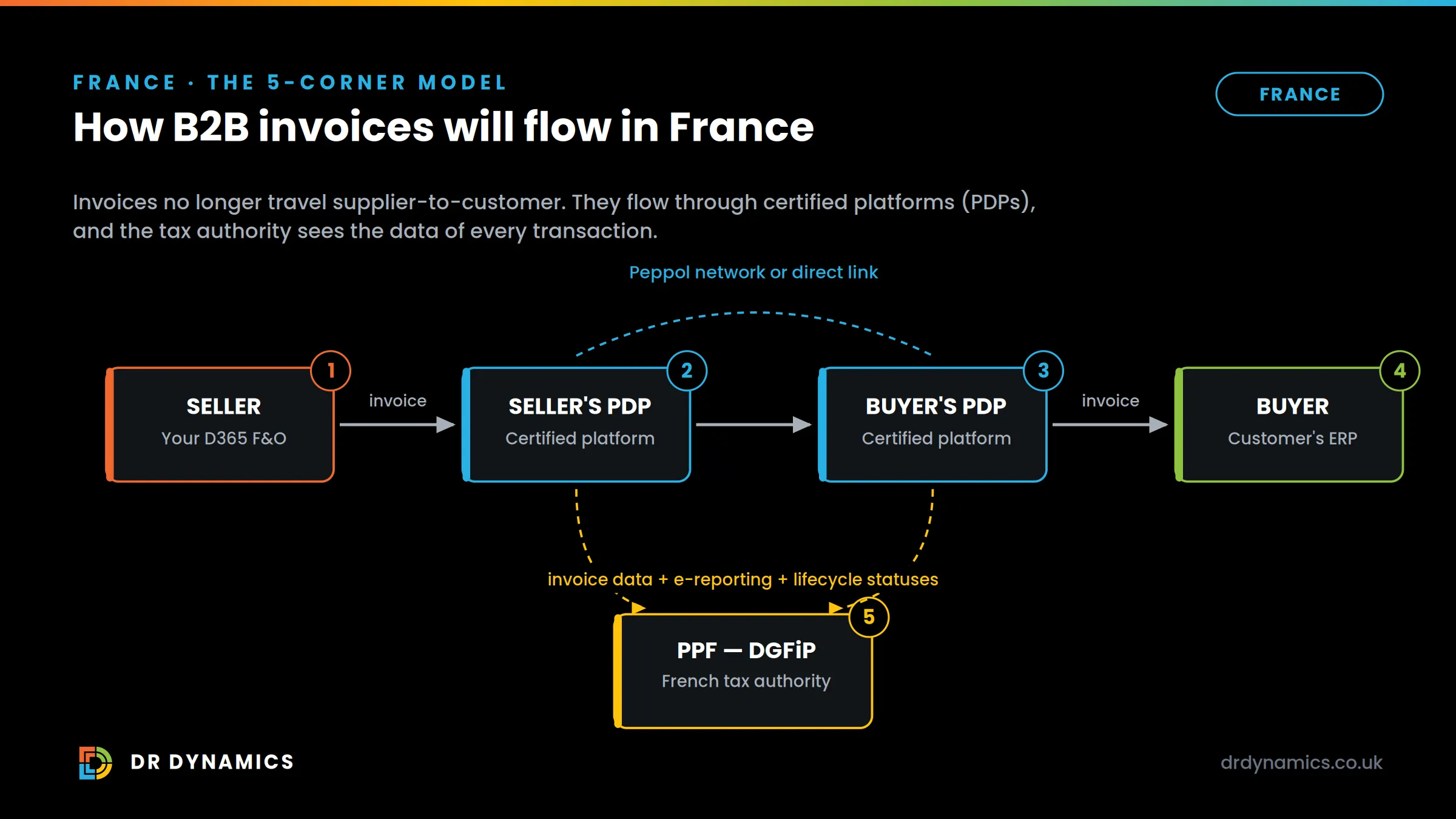
Practical consequence: choosing a PDP is now a procurement decision on your critical path. Your ERP no longer decides whether an invoice reaches your customer — your platform does.
The deadlines
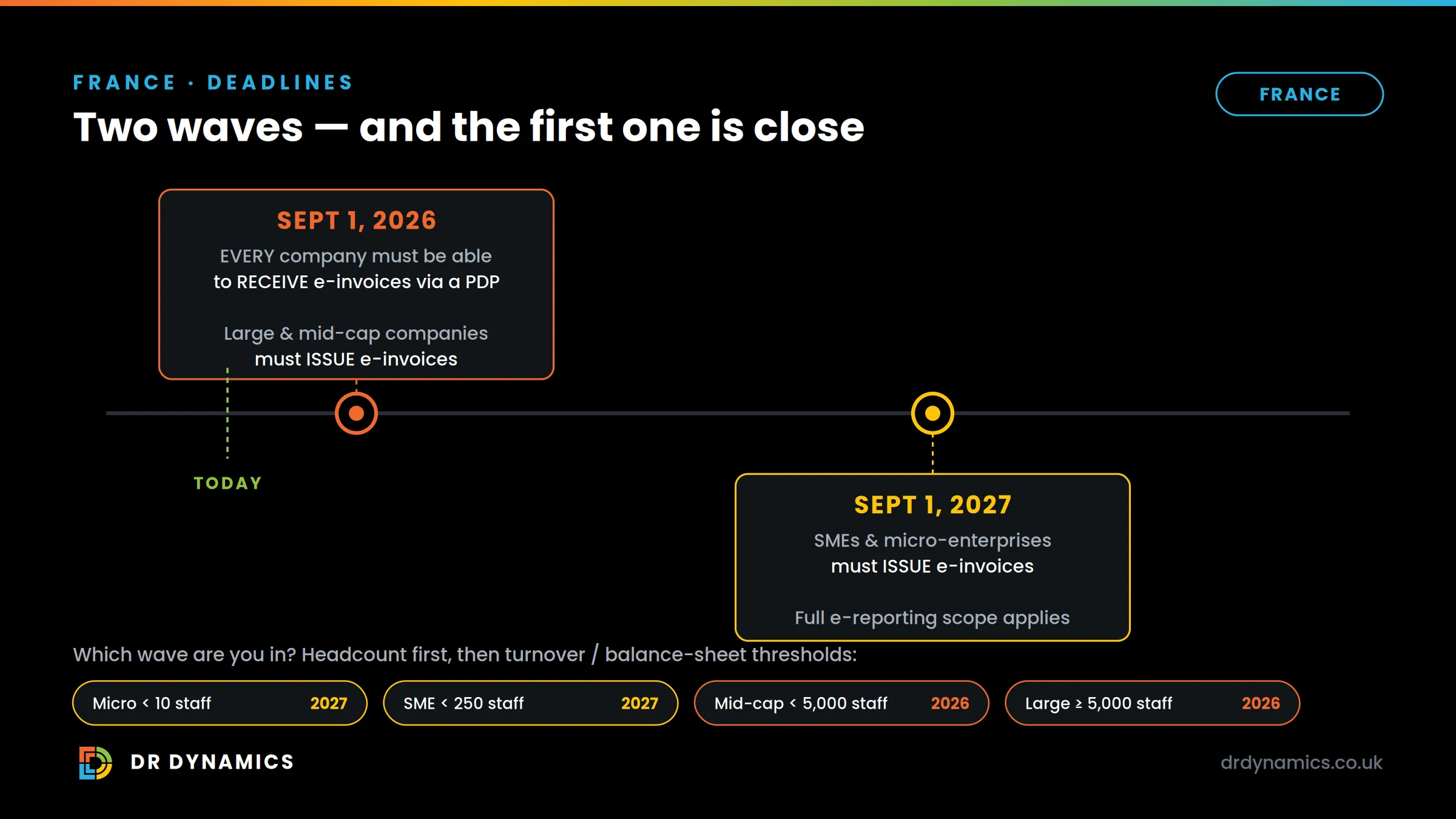
Two waves, sized by company category. From September 1, 2026, every company operating in France must be able to receive e-invoices through a PDP, and large companies and mid-caps (ETI) must issue them. From September 1, 2027, issuing extends to SMEs and micro-enterprises.
The category test trips people up: look at headcount first, then check whether you fail both the turnover and balance-sheet thresholds. A 200-person company with €60M turnover and a €50M balance sheet is not an SME — it fails both financial tests and moves up a category, which pulls its go-live forward a full year to 2026.
E-reporting: France sees your transactions even when there’s no e-invoice
Anything outside domestic B2B still gets reported: international B2B, exports, and B2C sales flow to the DGFiP through four reporting streams — transaction data and payment data, for international and B2C respectively.
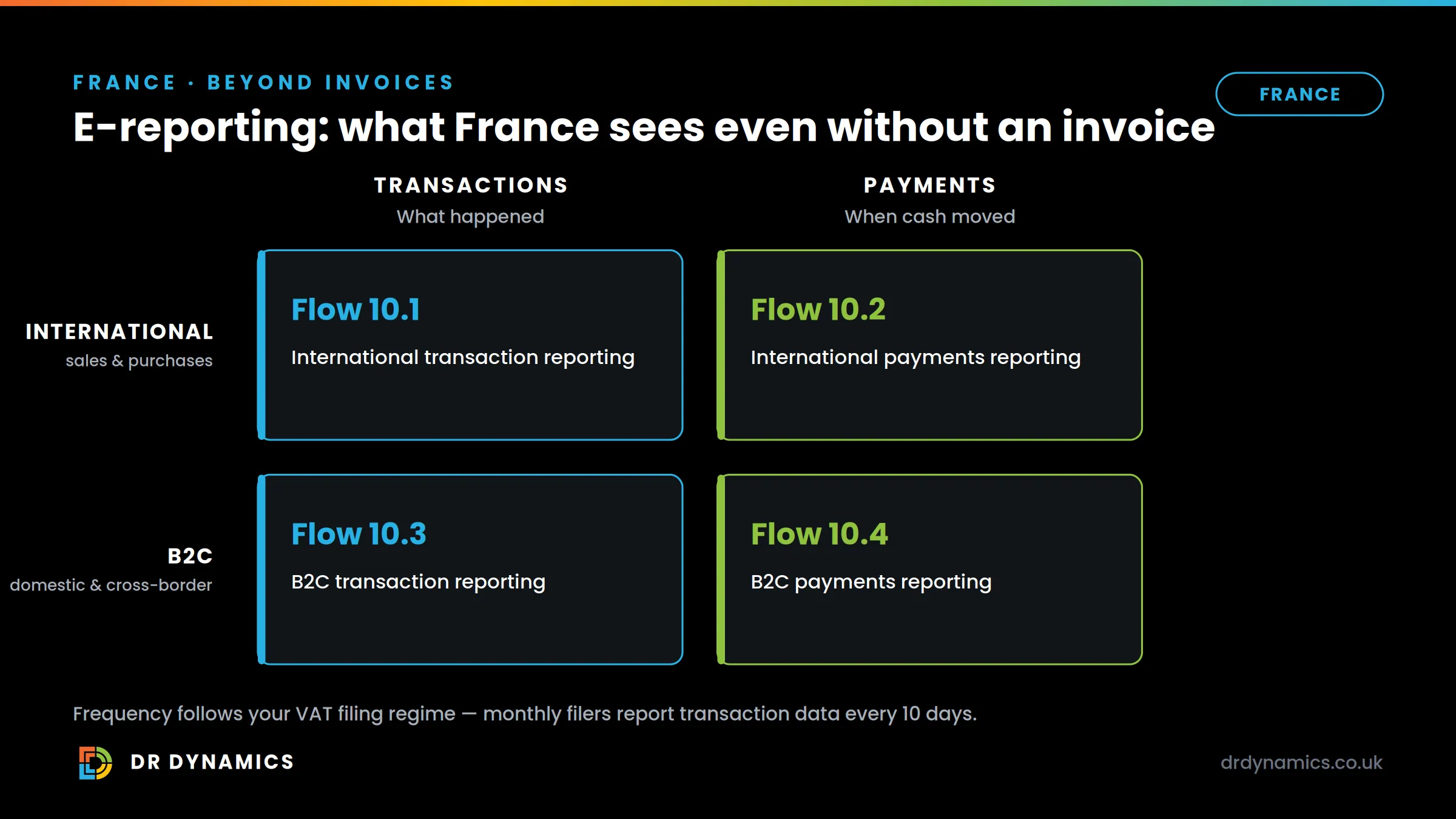
Frequency follows your VAT regime. Monthly filers submit transaction data every ten days. This is an always-on data pipeline, and it has to run reliably from day one.
Who must do what
The obligations differ depending on whether you are established in France or merely VAT-registered there. These two tables are worth keeping:
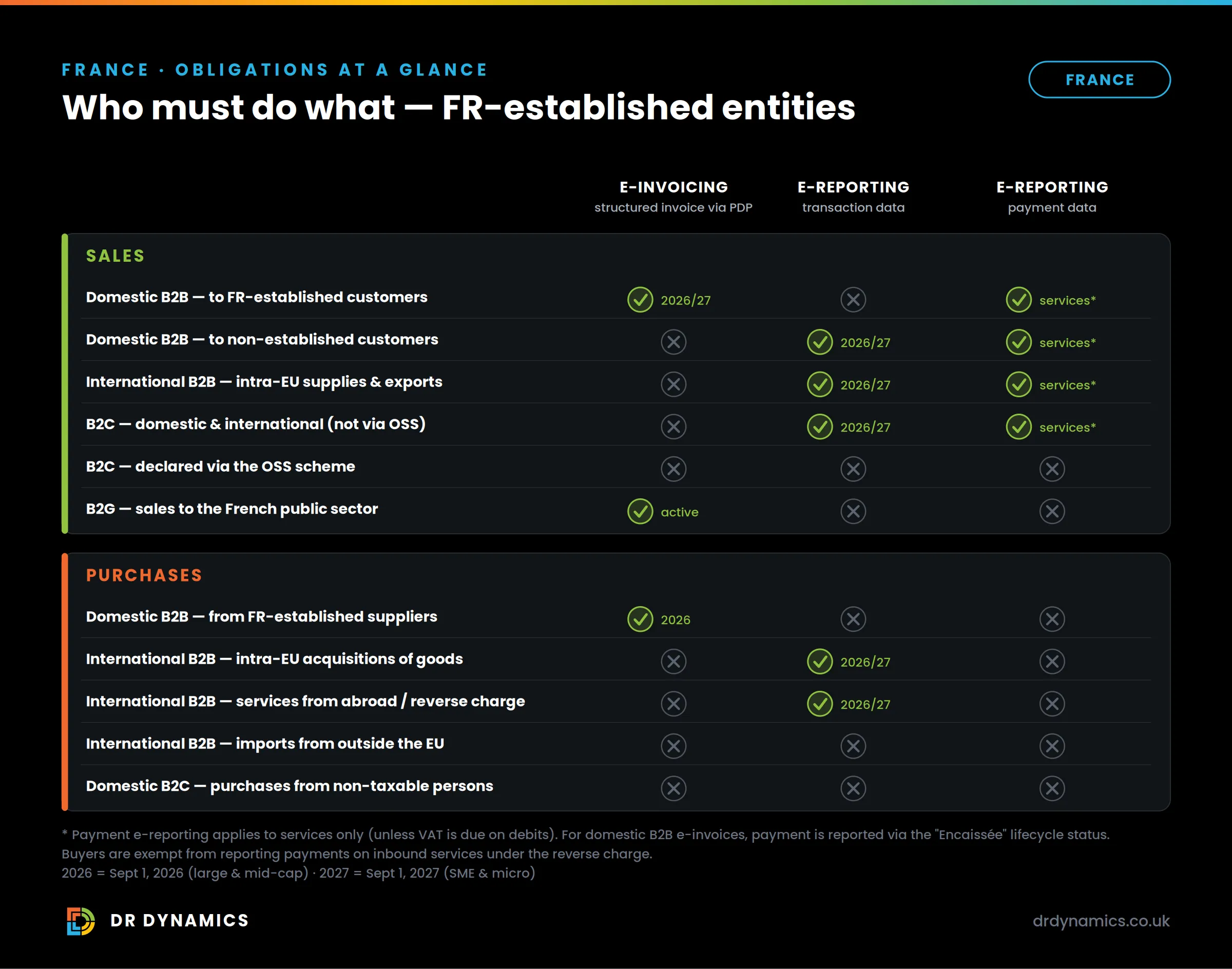
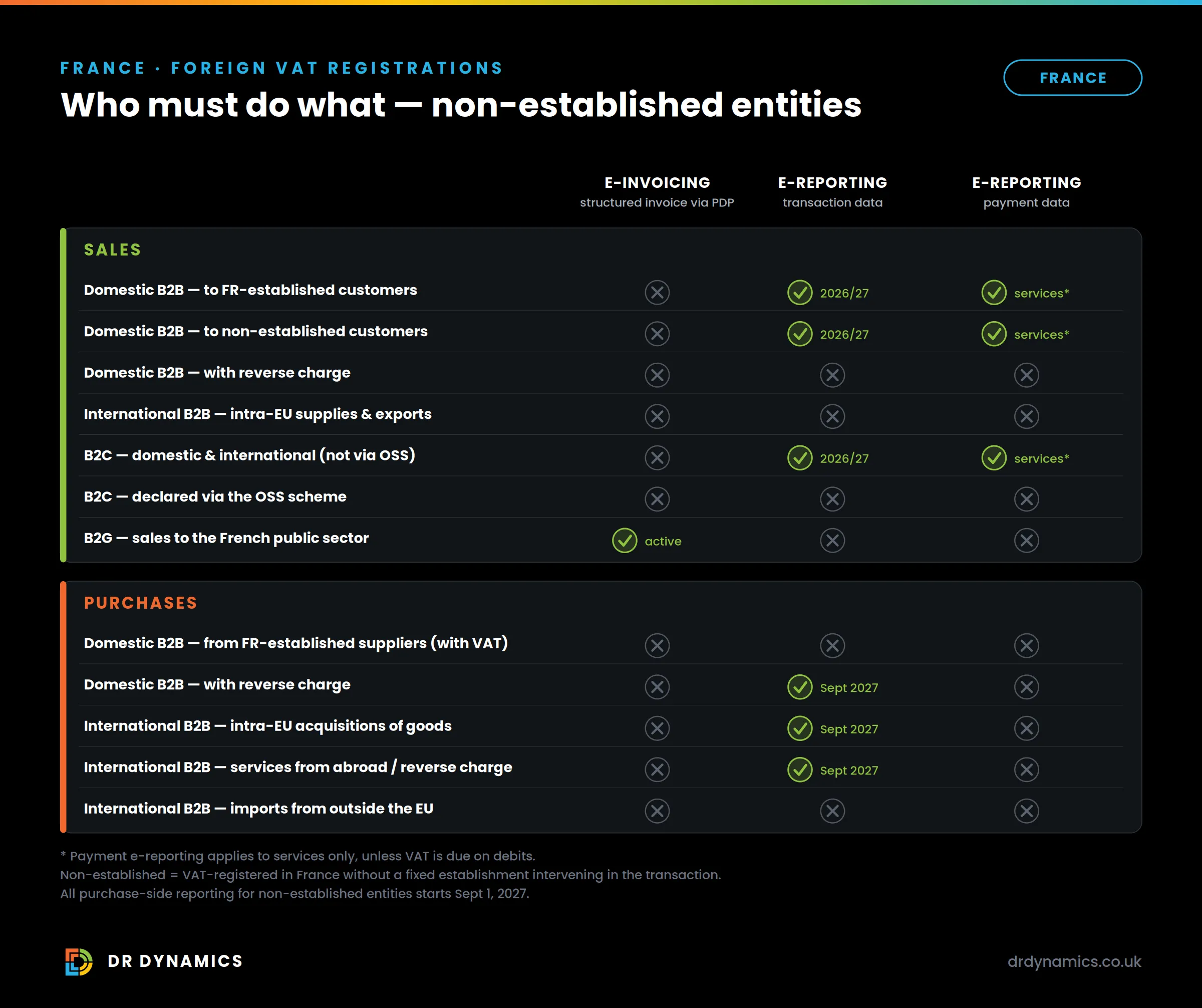
Note the purchase side for foreign VAT registrations: from September 1, 2027, non-established entities must e-report their French purchases under reverse charge and intra-EU acquisitions. Many international groups have quietly missed this one.
The data problem nobody budgets for
France extended the EU core invoice standard with its own profile covering 44 use cases and over 700 data fields. Several data points become mandatory that most D365 F&O environments don’t reliably hold today: SIREN/SIRET for both parties (the DGFiP must identify everyone unambiguously), an explicit invoice classification as goods, services or mixed (it drives when VAT falls due), delivery addresses where they differ from billing, structured notes instead of free text, and structured discounts and early-payment terms.
If your customer master lacks clean SIREN numbers, that is your longest lead-time item. Start there.
Germany: the opposite philosophy, the same destination
Germany wants the same thing France wants — structured EN 16931 invoice data for every domestic B2B transaction — but chose a radically lighter route.
The deadlines
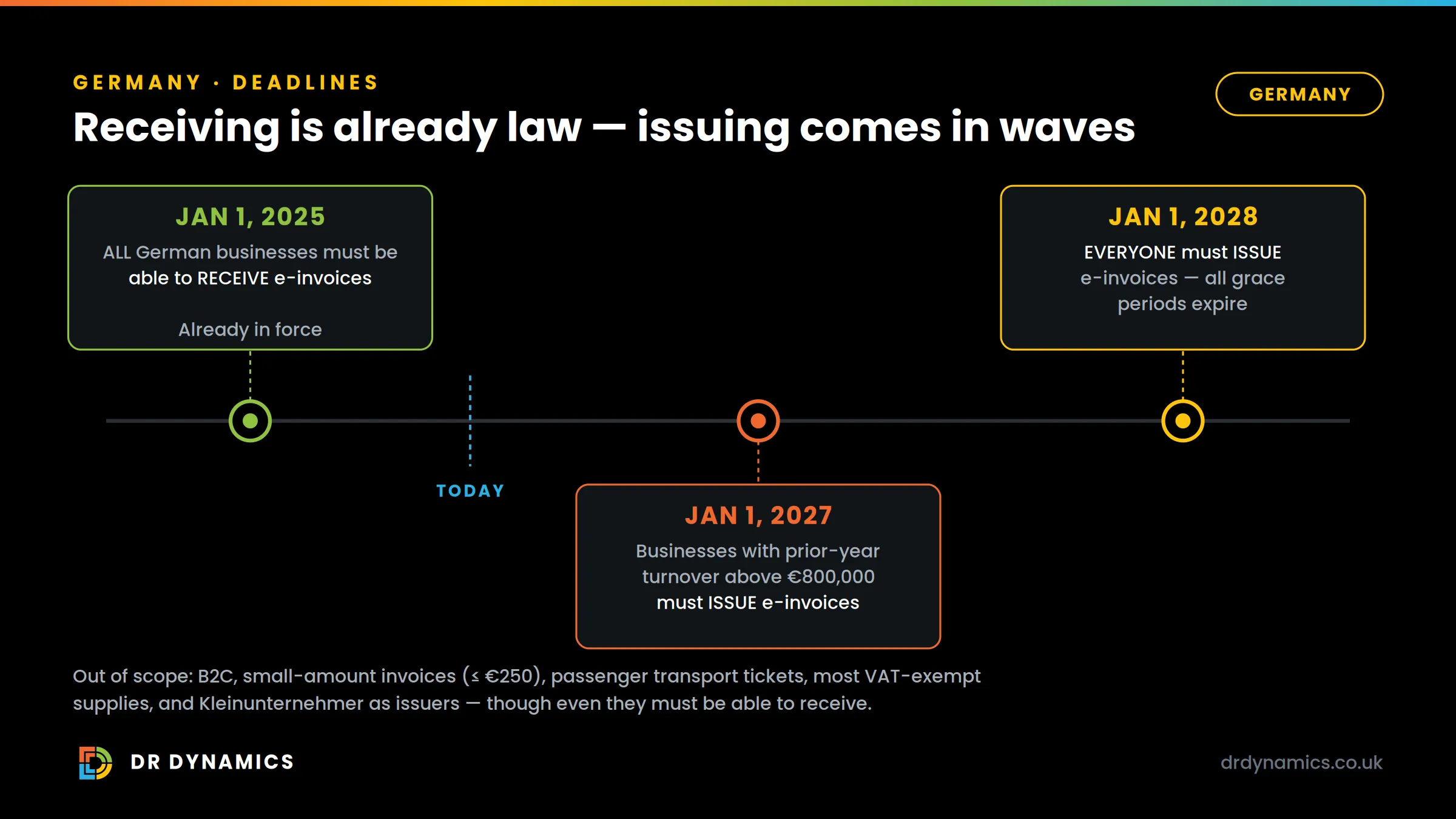
Since January 1, 2025, every German-established business must be able to receive structured e-invoices. From January 1, 2027, businesses with prior-year turnover above €800,000 must issue them. From January 1, 2028, everyone must, and every grace period expires.
Scope is narrower than France: domestic B2B between German-established companies. B2C is out, B2G was already mandatory, and small-amount invoices (up to €250), passenger transport tickets, most VAT-exempt supplies and Kleinunternehmer issuers are excluded — though even exempt small businesses must still be able to receive.
No platforms, no clearance, no government portal
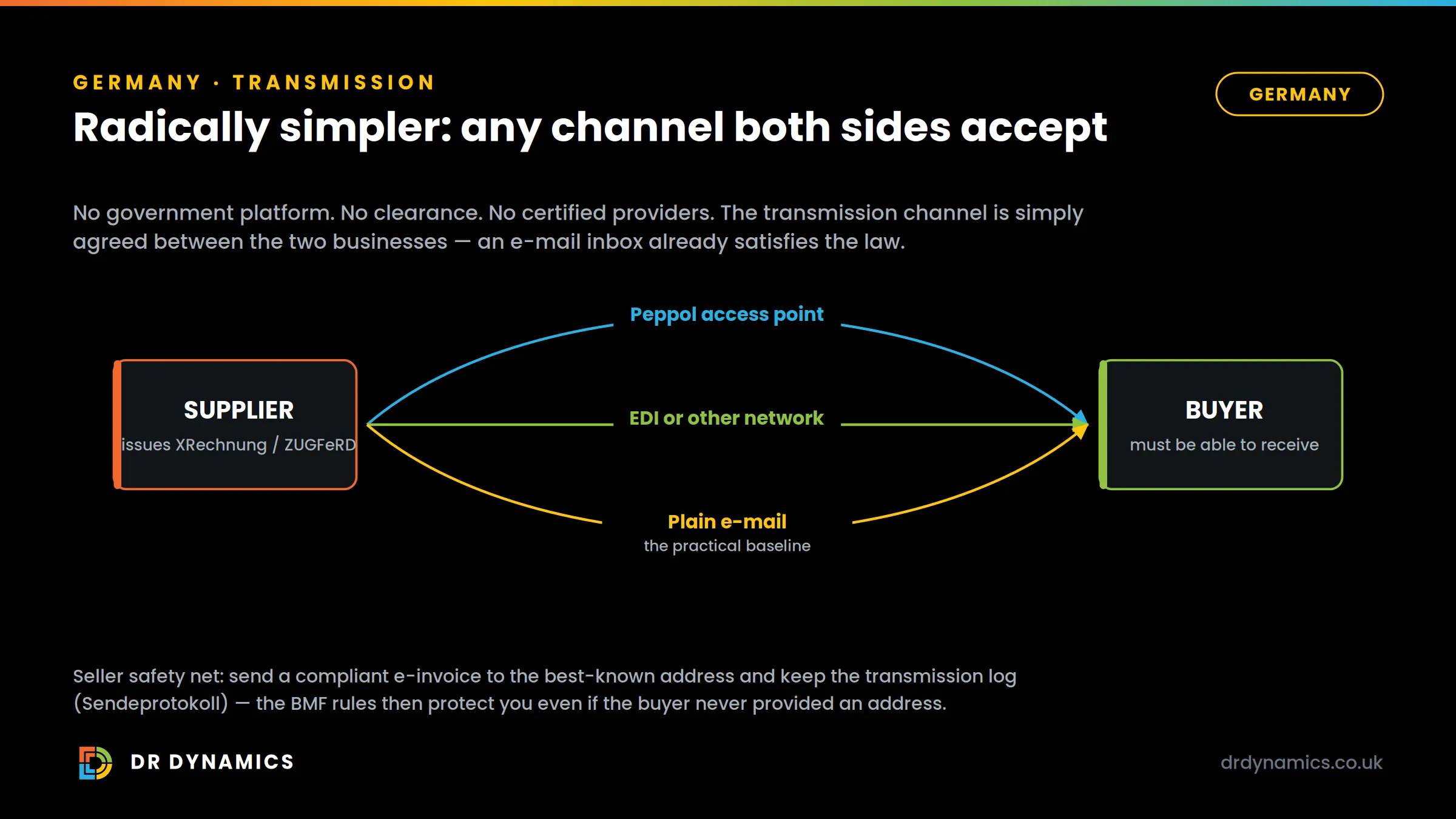
There is no German PPF and no certified provider requirement. The transmission channel is agreed between the two businesses, and an e-mail inbox legally suffices. There’s even a safety net: if a customer never provides an address, a supplier who sends a compliant e-invoice to the best-known address and keeps the transmission log (Sendeprotokoll) is protected under the BMF rules.
Simple to comply with, then. But deceptively easy to comply with badly — a compliant XRechnung landing in a shared mailbox that nobody parses is a failed AP process, not a solved one.
The format transition window
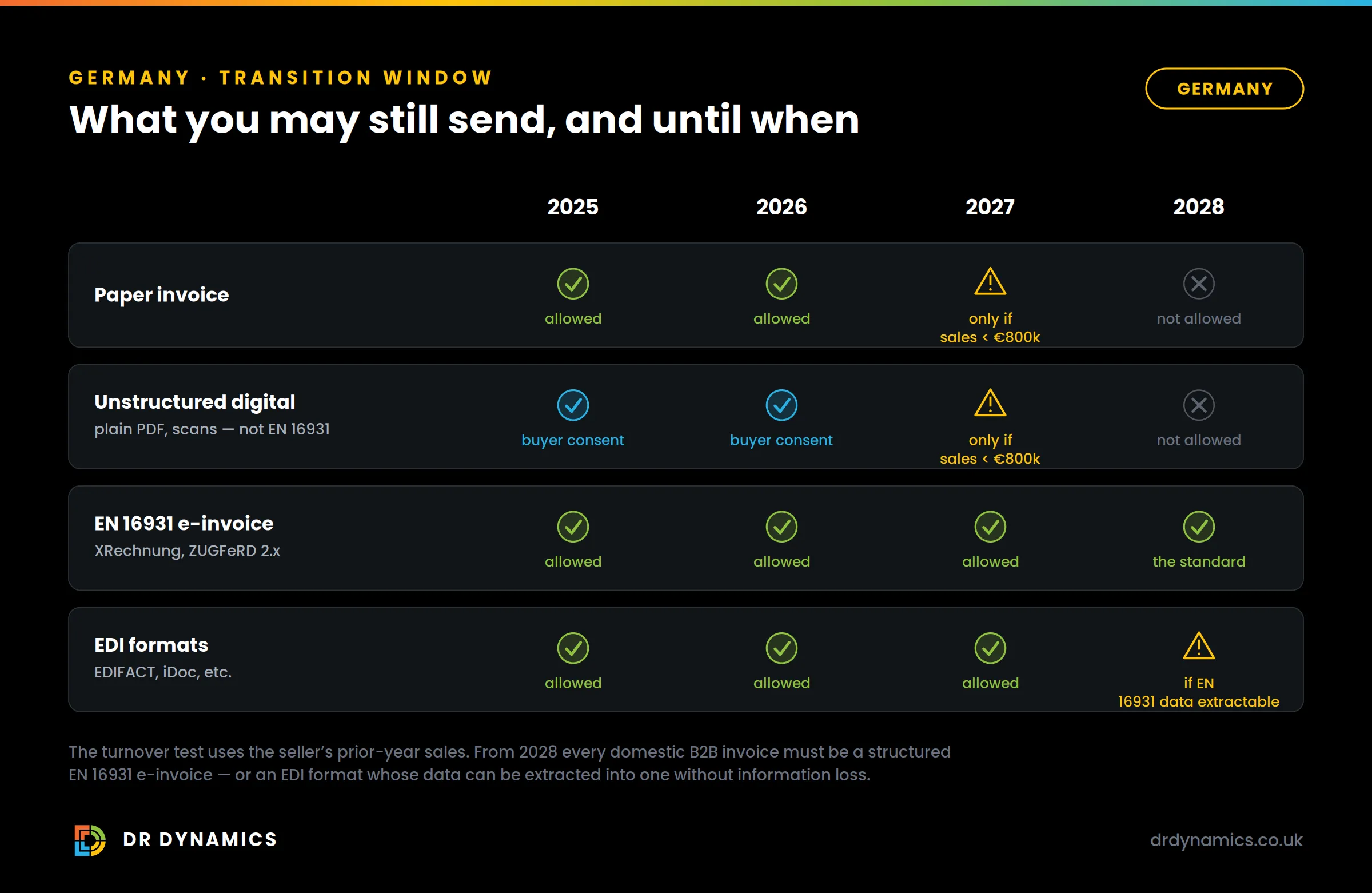
Paper and unstructured PDFs survive only until the issuing waves catch up with the sender. EDI keeps a grace period until 2028, after which EDI data must be extractable into EN 16931 without information loss. One detail that matters legally: in a hybrid ZUGFeRD invoice, the embedded XML is the binding tax original, not the human-readable PDF. Archive accordingly.
Your real German decision is on the purchase side
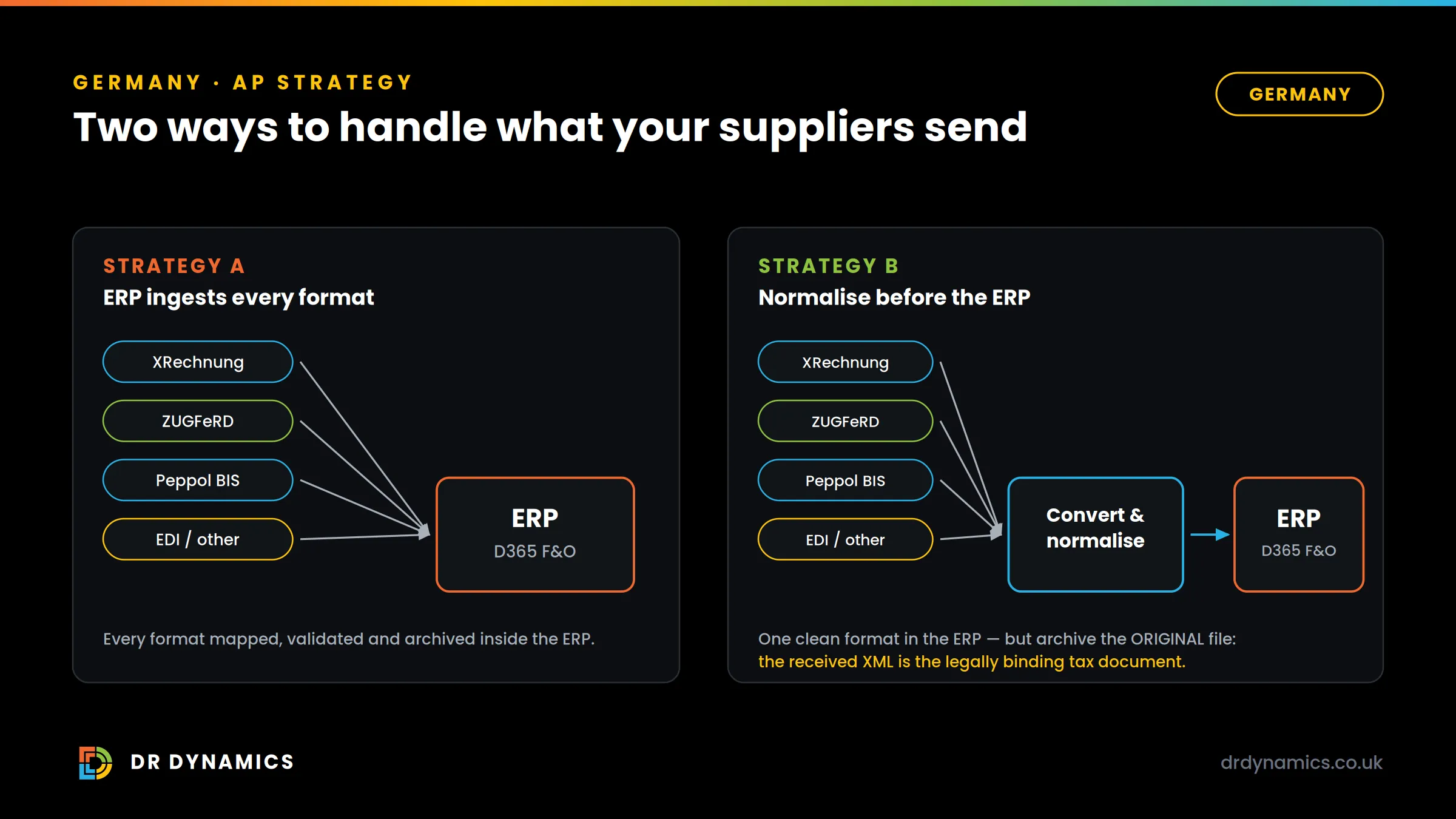
From 2027–2028 your German entities will receive XRechnung, ZUGFeRD, Peppol BIS and legacy EDI, all at once. You either make the ERP ingest every format natively, or you normalise everything into one format before it reaches the ERP — and keep the original file, because that original is the legal document.
The two mandates, side by side
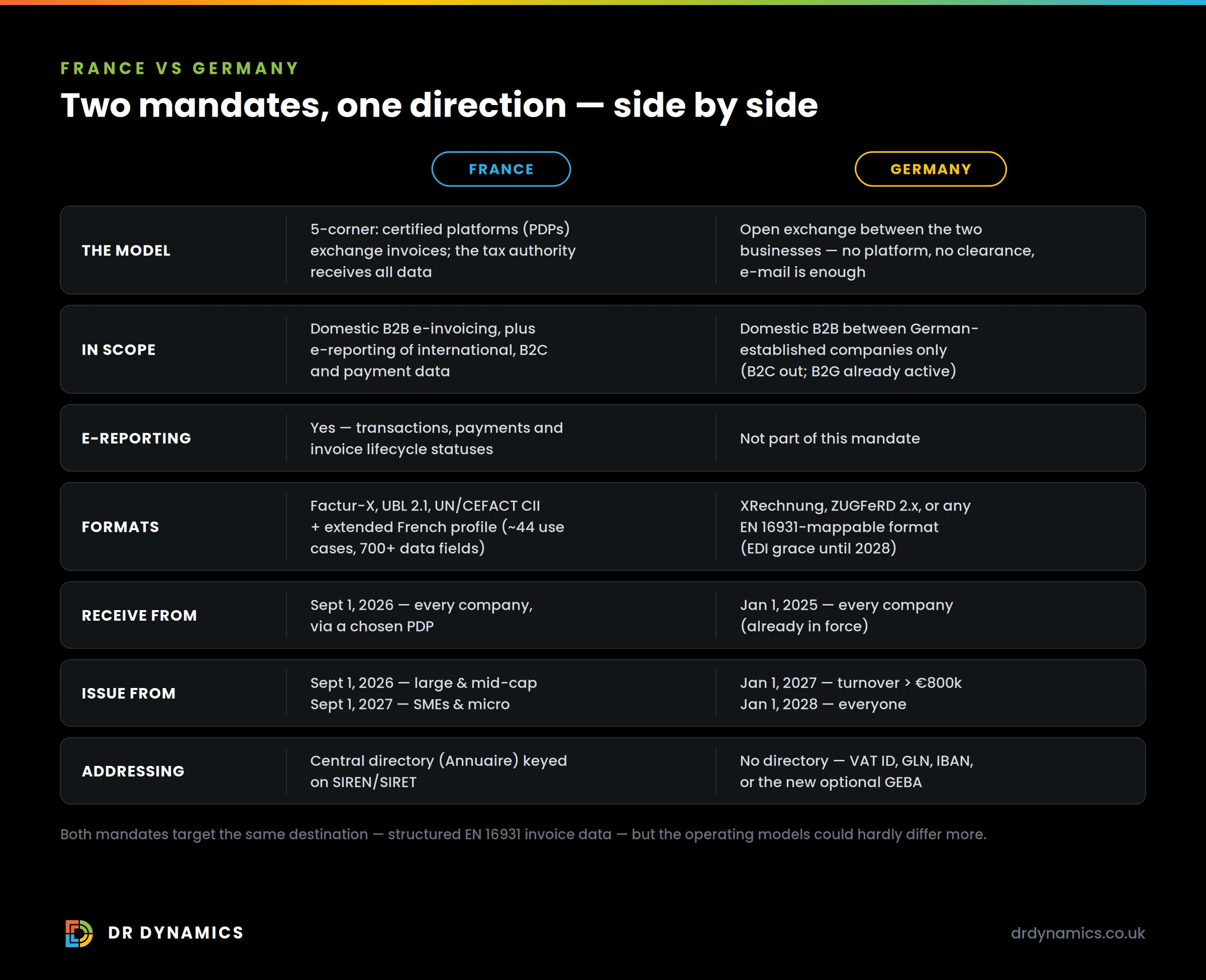
Same destination, opposite operating models. France gives you a regulated ecosystem with certified platforms, a central directory and tax-authority visibility over transactions, payments and invoice statuses. Germany hands the plumbing back to the businesses and simply demands the format. Your French project is a compliance and integration programme; your German project is mostly an AP automation and master-data exercise that happens to have a legal deadline.
Group CIOs should resist the temptation to treat them as one rollout. They share a foundation — clean master data, EN 16931-capable invoice generation from D365 F&O, structured archiving — and that foundation is worth building once. The country layers on top differ substantially.
What to do now if you run D365 F&O
For France: confirm your company-size category and go-live wave, select your PDP, register your entities’ electronic addresses in the Annuaire, and start cleaning SIREN/SIRET data on the customer and vendor masters. Then map your invoice scenarios against the French use cases — factoring, self-billing, multi-order invoices and intercompany all behave differently under the extended profile.
For Germany: verify your entities crossed (or will cross) the €800k threshold, decide your issuing format (XRechnung or ZUGFeRD), pick your AP ingestion strategy, and fix your archiving so the received XML original is retained.
For both: run a test cycle well before the legal date. An invoice rejected by your customer’s platform on day one is a cash-flow incident, not an IT ticket.
How we can assist
Dr Dynamics helps D365 F&O organisations get through exactly this. We run the impact and gap analysis against your current F&O configuration, help you choose the right e-invoicing provider or PDP for your footprint, and then build and test the integration between Dynamics 365 F&O and that provider — including the French extended data requirements, lifecycle statuses and e-reporting flows, and the German format and archiving rules. The approach and architecture are described in our solution page: eInvoicing for Dynamics 365 F&O.
If France’s September 2026 wave applies to you, the realistic window for provider selection, integration and testing is already tight. Get in touch and we’ll tell you, honestly, how much runway you have left.