In brief
The 1 September 2026 deadline holds, and so do the penalties. What Bercy announced in July is a listening and support phase to the end of 2026, not a période blanche, and the law was not amended. What changed is how DGFiP decides who actually gets fined: good faith, dialogue and proportionality, assessed against the evidence you can show. The sharpest detail is the reception obligation. First-offence relief under CGI Art. 1737, V does not extend to Art. 1737, IV bis, so failing to be connected to a plateforme agréée to receive invoices carries no safety net and no annual cap.
France did not give you a grace period. It gave you the benefit of the doubt. There is a difference, and most of the summaries I read in July collapsed the two.
Here is what happened, what it costs if you get it wrong, and the one obligation that carries no safety net at all.
What actually changed in July
David Amiel, ministre de l’Action et des Comptes publics, announced on 10 and 11 July 2026 an “approche de tolérance et de bienveillance” in the rollout of the reform. It sits inside a phase d’écoute et d’accompagnement running until the end of 2026. You can read the announcement in the ministry’s press release.
The ministry then said the thing everyone skipped. This does not create a “période blanche”. It is not a grace period, not a delay, not a suspension. The law was not amended. The penalties are in force from the first day.
What changed is how DGFiP decides who gets fined. The stated criteria are good faith, dialogue and proportionality. A business acting in good faith, documenting its difficulties and working to remediate them, will not be sanctioned. “Case by case” is my paraphrase rather than official wording, but it is a fair one. Enforcement is aimed at total absence of effort, or deliberate refusal to enter the system.
There is also a support line. DGFiP runs 0806 807 807, Monday to Friday, 8:30 to 18:00. Use it, and log the call. More on why that matters below.
Who is in scope, and when
From 1 September 2026, VAT-taxable persons established in France that are in scope must be able to receive e-invoices through a plateforme agréée. Large and mid-sized companies must also issue through one from the same date.
From 1 September 2027, SMEs, micro-businesses and other smaller VAT-taxable persons must issue. Earlier opt-in is allowed.
Two points that trip teams up. First, the trigger is VAT-assujetti status, not legal form. If you are a taxable person, you are in scope. Non-assujettis are out. Second, the terminology moved. DGFiP dropped “PDP” in July 2025 in favour of plateforme agréée, or PA. If your project documents still say PDP, it is the same thing under a new name, and your provider list did not change underneath you.
On the date itself, there was a real mechanism to move it. CGI Art. 1737 contains a decree power capped at 1 December 2026. No deferral decree was made. Décret n° 2026-677 and the arrêté of 27 July 2026 completed the framework without touching the date. 1 September 2026 is confirmed.
The penalties, in plain numbers
| Obligation | Penalty | Cap | Article |
|---|---|---|---|
| Issue invoices electronically when required | €50 per invoice | €15,000 per calendar year | CGI Art. 1737, III |
| Transmit transaction data (e-reporting, art. 290) | €500 per missed transmission | €15,000 per calendar year | CGI Art. 1788 D, I |
| Transmit payment data (e-reporting, art. 290 A) | €500 per missed transmission | €15,000 per calendar year | CGI Art. 1788 D, II |
| Connect to a plateforme agréée to receive | €500, then €1,000 per further three-month period | None | CGI Art. 1737, IV bis |
Three things to read carefully in that table.
The €50 per invoice is new money. The 2026 Finance Law, loi n° 2026-103 of 19 February 2026, raised it from €15. If your risk model was built on the old figure, it is out of date by a factor of more than three.
The two €15,000 e-reporting caps are expressed separately, one in each paragraph of Art. 1788 D. Transaction data has its own ceiling and payment data has its own ceiling. Do not present that to your finance director as a single combined €15,000. It is not.
And the last row has no cap at all. That one deserves its own section.
The one penalty with no safety net
There is first-violation relief in the law, and it is genuinely useful. A first issuance or e-reporting violation, in the current year or the three preceding years, is not fined if you correct it voluntarily or within 30 days of the authority’s first request. That relief lives in CGI Art. 1737, paragraph V, and in Art. 1788 D, V.
Read paragraph V closely. It covers paragraphs I to IV. It does not cover IV bis.
IV bis is the penalty for failing to be connected to a plateforme agréée to receive invoices. The sequence runs like this. You get a mise en demeure with three months to comply. Then €500. Then a fresh mise en demeure with three months. Then €1,000. Then a further €1,000 after each subsequent three-month period following an unsuccessful notice. It is a flat repeating €1,000, not an escalating amount, and there is no annual ceiling.
So the obligation that hits every in-scope business on 1 September 2026, including the small ones that do not have to issue until 2027, is the single obligation with no first-offence relief and no cap. If you are triaging work with four weeks left, reception is the thing to fix first. Everything else has a floor under it. This does not.
What a genuine compliance trajectory looks like
If you cannot be fully ready, the trajectory is what DGFiP will assess. The guidance is about evidence, and it is specific. Concrete, dated, coherent. A statement of intent is not enough.
Assemble this now, not in October:
- the PA you chose or contracted, and when
- written exchanges with your software provider, accountant, bank or platform
- your timeline for connection, configuration and deployment
- which flows are already electronic and which are not
- tests run or scheduled
- support tickets, error messages and incident notifications
- transitional measures keeping the business trading
- planned actions to regularise invoices or data that could not follow the process
- internal instructions issued to your invoicing, accounting and payment teams
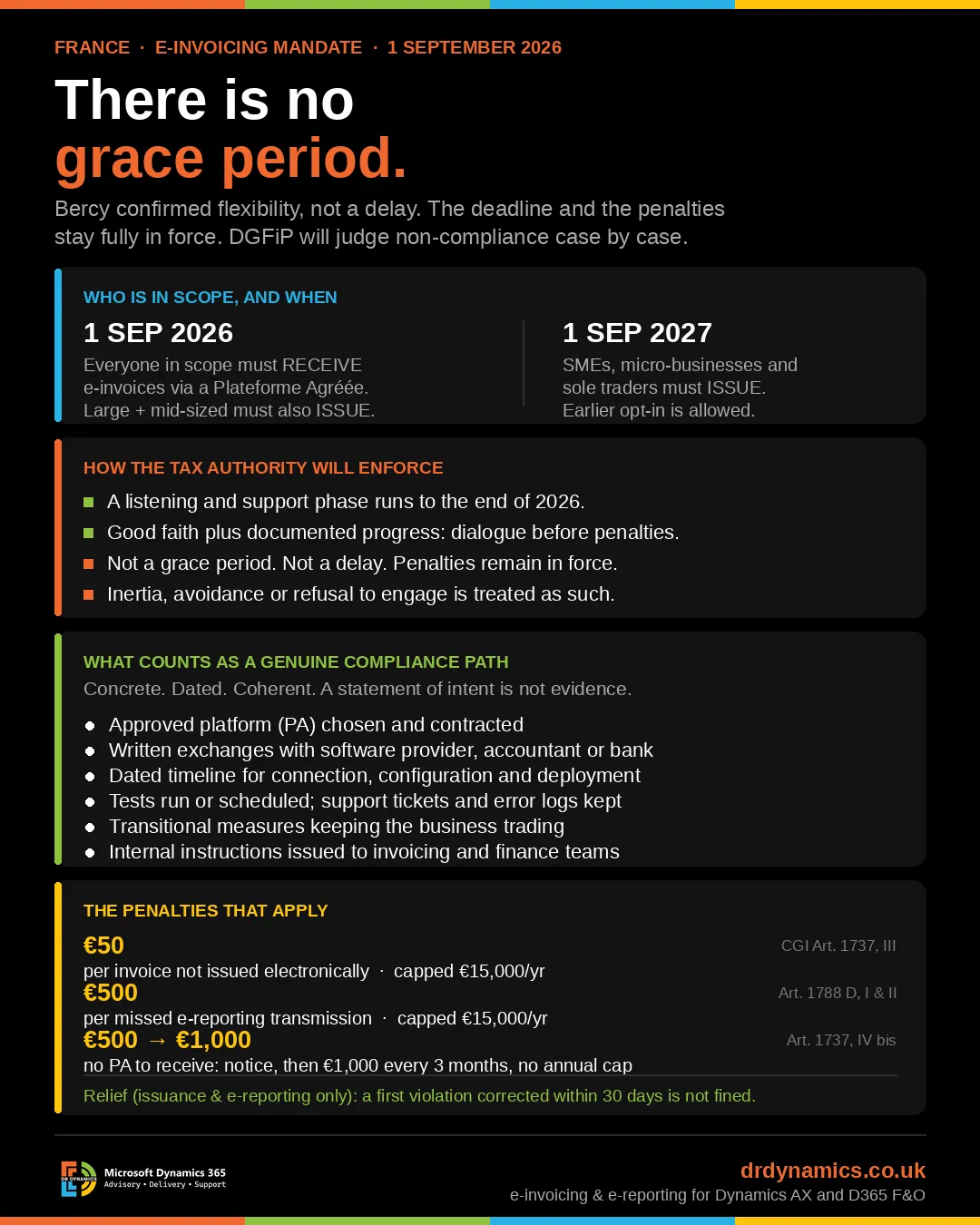
Most teams I speak to have most of that in someone’s head. Written down, with dates against it, is a different thing entirely. If it is not written down, it does not exist as far as an assessment is concerned. The ministry has published its own accompaniment material at economie.gouv.fr, and the support-line calls you log are part of the same evidence trail.
What this means if you are on Dynamics AX or D365 F&O
Reception is where I see the estimate go wrong. Teams scope it as a mailbox. It is not. An inbound French e-invoice arrives as structured data through your PA, and it has to land in AP as a vendor invoice your team can process, match and pay.
Then the statuses come back the other way. France mandates a lifecycle: Deposited, Rejected, Refused, Cashed. Those are not decorative. Your ERP has to consume them from the PA, map them onto the source invoice, and surface them where finance can act. A Refused that nobody sees is a compliance gap with a date on it. A Cashed status is what closes the VAT-on-receipts timing question. Get the status loop wrong and you have an open-loop solution that will not survive an audit, even though every invoice technically went out.
That is buildable on both platforms, and we have built it. The approach for each is on the solution pages: eInvoicing for Dynamics AX if you are still on AX 4.0, 2009 or 2012, and eInvoicing for Dynamics 365 Finance & Operations if you are on F&O.
The trajectory is your fallback, not your plan
I want to be blunt about the order of these two things. Building an evidence file is sensible risk management. It is not a compliance strategy. Every hour you spend documenting why you are late is an hour you did not spend getting connected.
Be compliant on 1 September and you never have to argue your case. That is the whole point.
If France is in scope and you are not certain where you stand on reception, get in touch and we will look at it with you.