In brief
On 13 August 2026 Microsoft changed the Sales, Service, Finance and Supply Chain specializations: eligible deployments are now measured in monthly active users rather than monthly consumption value, the gross growth requirement is removed, and Marketplace tags were refreshed. Removing gross growth is the material change, because it stopped penalising practices built on a few large enterprise programmes. Four inputs still decide the outcome: three new large Finance and Operations deployments, an eligible partner association, five intermediate and two advanced certifications, and a tagged Marketplace consulting offer. There is no audit and there are no customer references, so the data has to be right on its own. Partner association at kickoff is where most evidence is lost.
Microsoft simplified eligibility for four Business Applications specializations this month. It is a good moment to ask what your delivery actually proves.
Every D365 practice carries a gap between the work it has delivered and the work Microsoft can see.
The gap surfaces at the same moment every year. Six weeks before the specialization anniversary, someone opens Partner Center, and the number is short. Not because the work wasn’t done. Because it wasn’t recorded in the system Microsoft counts.
That is a delivery governance problem wearing a marketing costume. Microsoft has just made it easier to close.
What changed in August 2026
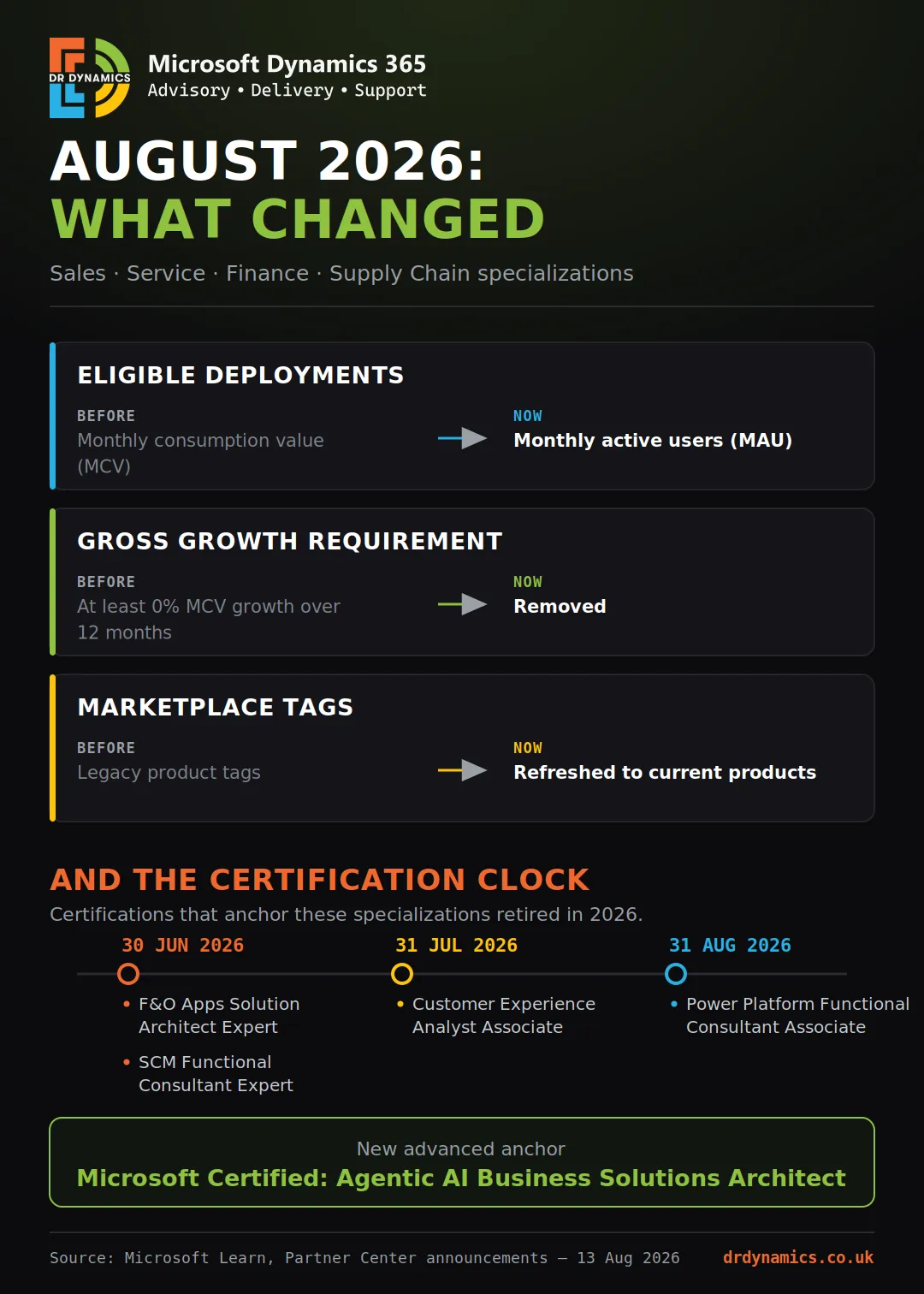
On 13 August 2026, Microsoft published three changes to the Sales, Service, Finance, and Supply Chain specializations in its monthly Partner Program update:
- Eligible deployments are now defined by monthly active users (MAU) instead of monthly consumption value (MCV).
- The gross growth performance requirement is removed.
- Microsoft Marketplace tags are updated to match current products.
Microsoft’s own headline on the follow-up post was “Eligibility simplified for four Business Applications specializations”, published 21 August. Simplified is the right word. This makes the criteria easier to read and easier to hit, and it removes a rule that penalised the wrong partners.
The MAU switch is smaller than it sounds. The gross growth removal is bigger.
Take the MAU change first, because it reads like a new bar and isn’t.
MCV was never a separate measure. Microsoft’s published rate card calculates monthly consumption as active users or capacity multiplied by a workload rate, and Finance and Operations carries a rate of 100 per monthly active user. A “large deployment” set at more than 5,000 MCV therefore meant roughly fifty people using the system. Usage was always the underlying signal. What changes is that the number is now expressed in a unit your customer’s own administrator can count, which makes it something you can forecast during a programme rather than reconcile after one.
The gross growth removal is the material one.
Under the criteria as previously published, Finance and Supply Chain required at least 0% MCV gross growth across the trailing twelve months, measured against a 25,000 MCV baseline. That rule quietly punished specialist consultancies. One client consolidating legal entities, one customer pausing a rollout, one large estate rationalising licences, and a portfolio built on a handful of enterprise programmes could fall below the line for reasons that had nothing to do with the quality of the delivery. Practices with many small customers absorbed that variance. Practices with a few large ones did not.
Dropping it makes the measurement fairer to exactly the kind of firm that does deep Finance and Operations work.
What Microsoft actually counts for Finance and Supply Chain
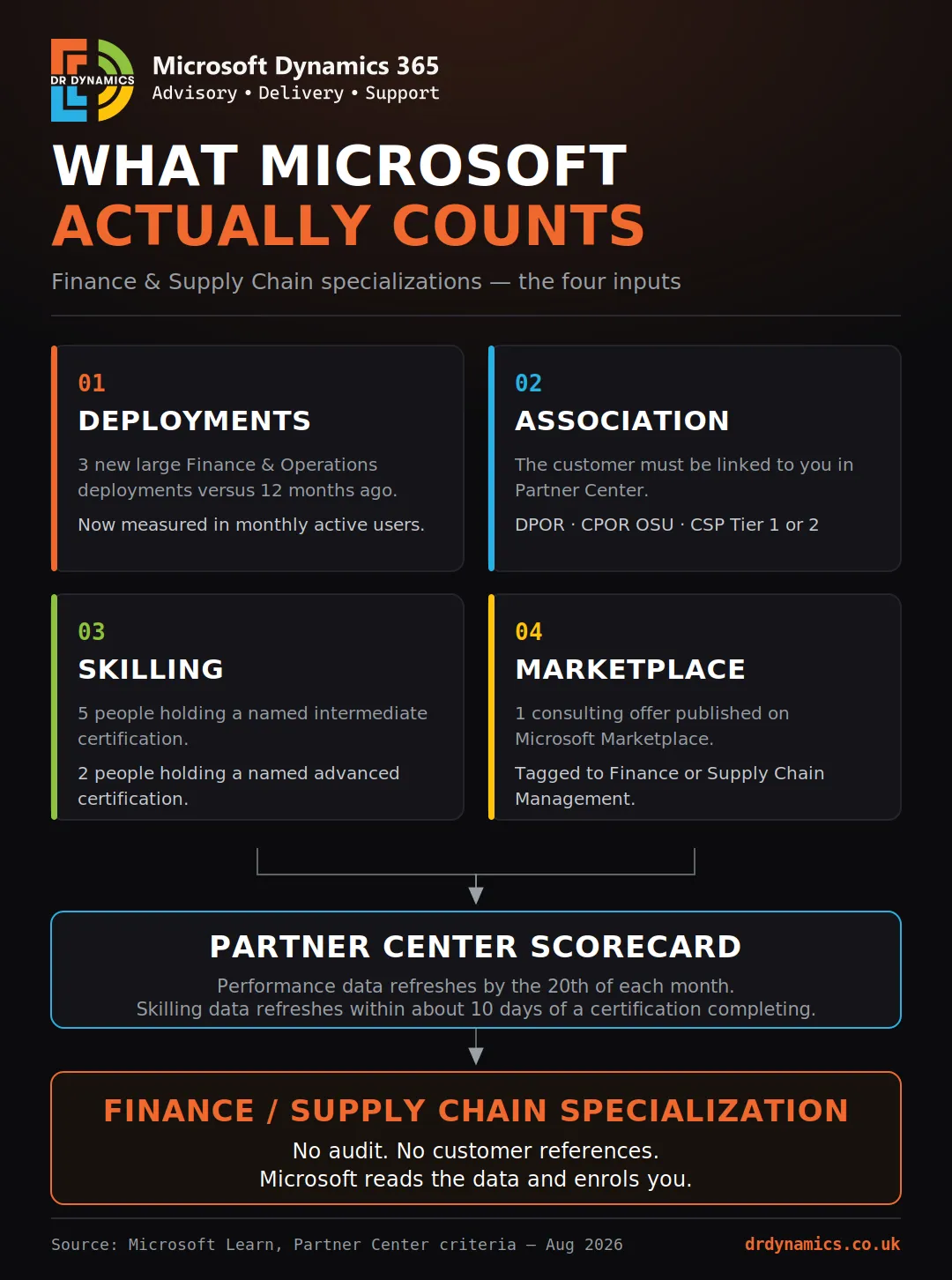
Strip the criteria back and there are four inputs. As published at the time of writing, both the Finance and Supply Chain specializations sit on the same structure:
1. Deployments. Three new large deployments from the Finance and Operations workload, measured against the position twelve months earlier. This is the metric now moving to MAU.
2. Association. The deployment only counts if the customer is linked to you through an eligible association type: DPOR, CPOR OSU, CSP Tier 1, or CSP Tier 2.
3. Skilling. Five individuals holding a named intermediate certification, and two holding a named advanced certification.
4. Marketplace. At least one consulting offer published on Microsoft Marketplace and tagged to the right product. Finance for the Finance specialization, Supply Chain Management for Supply Chain.
There is no audit and there are no customer references for Business Applications specializations. Microsoft reads the data and enrols you.
Which is precisely why the data has to be right. There is nobody to explain it to.
The association gap is where most evidence dies
Point 2 is the one that costs practices a specialization, and it is almost never a delivery failure.
You can run a two-year Finance and Operations programme, land it, and have it show up nowhere in your Partner Center scorecard. It happens when you deliver as a subcontractor to a larger systems integrator. It happens when the customer bought their licences through a different CSP. It happens when nobody claimed CPOR at go-live because everyone assumed someone else had.
The work happened. It just didn’t happen to you, as far as the record goes.
Programme plans routinely carry line items for the security role matrix, the data migration dry run, and the cutover rehearsal. Partner association almost never appears anywhere on them. It belongs in the same category and takes about the same effort as booking a meeting room: name the association type, name the owner, confirm it in Partner Center, close the task.
Do it at kickoff. Reconstructing it two years later means asking a customer’s IT director to do you an administrative favour on a project they have already moved on from.
The certification map moved this year
The skilling half has its own timing problem. Several certifications that anchor the Finance and Supply Chain criteria reached retirement in 2026:
- 30 June 2026: Dynamics 365 Finance and Operations Apps Solution Architect Expert, Dynamics 365 Supply Chain Management Functional Consultant Expert, Power Platform Solution Architect Expert, Dynamics 365 Field Service Functional Consultant Associate, Power Automate RPA Developer Associate
- 31 July 2026: Dynamics 365 Customer Experience Analyst Associate
- 31 August 2026: Power Platform Functional Consultant Associate
Certifications completed before a retirement date stay eligible for a defined window afterwards, and Microsoft publishes that window per certification. The replacement anchor at advanced level is Microsoft Certified: Agentic AI Business Solutions Architect.
Read the implication rather than the list. If your advanced tier rests on two people holding the Solution Architect Expert certification, there is a clock running on your specialization that nothing in your delivery pipeline will warn you about.
The good news is that this is the fastest thing on the list to fix. Microsoft refreshes skilling data in Partner Center within about ten days of a certification completing. Performance data refreshes by the twentieth of each month. Once you start moving, the scorecard catches up quickly. The failure mode is not slow remediation. It is late detection.
Put it in the delivery governance pack
None of this needs a new function. It needs five checkpoints attached to milestones you already run.
At kickoff: name the partner association type and the person who owns getting it registered. Confirm it before the first invoice goes out.
At design sign-off: record which workloads are in scope. Finance and Supply Chain work counts against the Finance and Operations workload. Sales and Service work counts against Common Data Service. That distinction decides which specialization your effort supports, and it is worth knowing before you build.
At go-live: baseline monthly active users. If your hypercare exit criteria don’t include a usage number, add one. It is a better measure of a successful go-live than an open defect count, and it is now the measure Microsoft applies.
At hypercare exit: confirm usage has grown, not simply that the tickets stopped. A quiet system is not the same as an adopted one.
Annually, sixty days before the specialization anniversary: run the certification position against the current criteria page, and check the Marketplace offer is still tagged to products that exist. Microsoft refreshed those tags this month, which makes this year’s check less optional than usual.
Five checkpoints. Perhaps two hours a year per programme.
If you are buying rather than selling
For a CFO or programme sponsor choosing a Finance and Operations partner, this is the part worth knowing.
A Business Applications specialization is not a badge someone applied for and argued their way into. It is Microsoft’s own telemetry saying that this firm has repeatedly deployed this workload and that the customers are using it. It is close to the only partner credential in the ecosystem that isn’t self-reported.
Three questions that separate a real capability claim from a slide: which Business Applications specializations do you currently hold, when do they renew, and how many of your Finance and Operations customers are associated to you in Partner Center? The third question is the one that gets an honest answer or a long pause.
The flywheel only turns if you capture the evidence while the work is happening
There is a loop available to any specialist practice. Better delivery produces measurable adoption. Measurable adoption produces credentials Microsoft can verify. Verified credentials sharpen positioning. Sharper positioning brings work that fits what you are actually good at, which produces better delivery.
Every stage of that loop depends on the first one being recorded. Reconstruct it after the fact and you get a case study. Capture it during the programme and you get a specialization.
Partner strategy and delivery strategy are not two disciplines that need aligning. The evidence is generated by delivery, so it has to be governed by delivery. Microsoft has now made the measurement simpler and fairer. The remaining gap sits on the partner side of the fence.
If you run a D365 Finance or Supply Chain practice, the question worth answering is whether partner association is a named task in your programme governance, or a conversation someone has with Partner Center once a year.